Blog


Nobel laureate Ayatollah al-Sistani

“As we approach the season of the Nobel Peace Prize, I would like to nominate the spiritual leader of Iraq’s Shiites, Grand Ayatollah Ali al-Sistani, for this year’s medal. I’m serious,” claims The New York Times’ columnist  Thomas L. Friedman, writing about the accomplishments of Grand Ayatollah Ali al-Sistani, the most prominent Shiite cleric in Iraq.

Friedman cites three main reasons that al-Sistani has contributed to the democratization of Iraq and, more broadly, the Middle East: al-Sistani has advocated a political strategy and vision of Iraq that has centered on positively and proactively focusing on the lives of Iraqis without resorting to defaming other movements or individuals; he has encouraged Iraqi voters, and not elite or self-appointed clerics, to have the commanding voice in post-occupation in Iraq; most importantly, in Friedman’s view, al-Sistani supports an understanding of Islam that is amenable to democracy. As Friedman characterizes it, in al-Sistani’s view, politics may be infused with Islamic values, but clerics will not be the dominant political force.

Ayatollah Ali al-Sistani’s most recent and most visible political role in reforming Iraq from beneath the rubble was to encourage his Shia followers to vote in the January 30th elections, whereas some Sunni organizations demanded that potential voters boycott the elections. Voter turnout was a staggeringly low 2 percent in some predominantly Sunni areas, as voters boycotted the elections or were intimated away from the voting booths by rampant violence.

Mimi Hanaoka


Seeking an escape route

Mythical stories of young soldiers disappearing across the border into Canada, in search of freedom from conscription, are the relics of the Vietnam era — or are they?  As The New York Times reported yesterday, a small group of currently enlisted men and women are seeking conscientious objector status, or seeking refuge across the United States’ northern border.  The difference for this generation of soldiers, however, is one of choice; all currently enlisted United States military are volunteers.

The Peace Out website, created by a group of veterans who successfully obtained conscientious objector status, received more than 3,000 hits its first day. No doubt, these numbers are due in part to conflicted sentiment over current armed combat in Iraq, but rather than see them merely as a reflection of as this, the Times article prompts us to question the stark differences between our military’s recruiting campaign, and the realities of life under fire. Soldiers recruited in peacetime,
and lured with the promises of steady employment and college education, did not expect to find themselves in combat in a country nine time zones away.

“It wasn’t what I thought it would be,” Private Hughey said. He said he enlisted at 17 from his home in San Angelo, Texas, because a recruiter promised that the military would buy him the education his father could not afford. He said he had tried to push aside little doubts he had, even back in basic training, but realized as his unit prepared to leave Fort Hood, Texas, for Iraq last March that he could not go.”

Current gossip mongering about the possibility of reinstating the draft obscures the embarrassing need to question the armed forces’ demographics. For our generation of soldiers, volunteering has grown scarily similar to conscription.

Laura Louison


Rev-ed up

It seems to me that the Western world, particularly in regard to areas that have any sense of authority, are only open to degree-educated people. I have been pondering the Church in my role as a pastor and I have come to the conclusion that the Church, as a global entity, is set up to cater, mostly, for middle-class, university-educated, people who respond to a lecture format of information dissemination and who also engage with ideas and concepts.

A key part of my calling is pastoral care. I, particularly, have a concern for those people who find themselves on the edge of the church. I meet weekly with a man suffering from bipolar disorder. It is not glamorous, cutting-edge ministry that will get me a cover shot on Christianity Today, but I feel, nonetheless, that it is worthwhile. I also meet with a schizophrenic man, and my wife and I are assisting a single mother in need at this time.

I share these things not to boast but in order to raise some thoughts. Of course, I do much more than this in my ministry, but these tasks for me are equally, if not more, valuable than my teaching role.

As I pondered this I began to think about how accessible politics is for the lower-class, lower-income person or for the mentally ill or the socially disadvantaged. Even websites such as this attract upper middle-class, university-educated people. I am not wanting to trigger a Monty Python-esque battle for the worst upbringing, and I am not at all minimizing the value of websites such as this, but what I want to raise is whether we, as socially concerned, politically active, spiritually aware, intelligent people, are creating structures that encourage the participation of those who fall through the cracks of society.

My contribution to this, in practical terms, is a drop in the ocean, but I am learning that I can only do what I can do. What are you doing? What more can I do? The political system in the U.S.A. is heavily loaded towards a wealthy minority who can afford to get involved. I want to assert that there is a place for grass-roots movements. I know that they are around. I would like to encourage anyone who is involved in political, social or spiritual engagement with people on the fringes of society to respond to this post or to email me. I would like to build a profile of positive contributions to society both in the U.S. and elsewhere.

What I have done here is to throw out some thoughts. This is not a comprehensive answer by any means but it is a beginning of sorts.  Will you join me in the journey?

Regards,
Rev. Les

—Les Chatwin


Reaching for equality through marriage

Dean E. Murphy reports today in the International Herald Tribune that Judge Richard Kramer has ruled in favor of same-sex marriage in response to a lawsuit filed by the city of San Francisco against the state of California. The current restrictions against same-sex marriage are based upon Proposition 22, which was approved in 2000 by California voters, and a law enacted by the Legislature in 1977. Kramer wrote,

“The idea that marriage-like rights without marriage is adequate smacks of a concept long rejected by the courts: separate but equal.

The state’s protracted denial of equal protection cannot be justified simply because such constitutional violation has become traditional.”   

Many of the arguments opposing same-sex marriage could be compared with those “once made against mixed-race marriages or racially integrated schools,” Kramer noted.

“The denial of marriage to same-sex couples appears impermissibly arbitrary,” he stated yesterday.

As Kramer must still meet with several parties to the litigation, the ruling will not become final until March 30.

—Michaele Shapiro


Quote of note

“Same-sex marriage cannot be prohibited solely because California has always done so before.”

— San Francisco Superior Court Judge Richard Kramer, writing today to explain his ruling, in which he declared that California’s current state ban on same-sex marriages violates citizens’ constitutional right to equal treatment. Kramer previously ruled in support of the same-sex couples when they, along with the city of San Francisco, sought legal recourse in March of 2004 after the Supreme Court annulled approximately 4,000 same-sex marriages that had taken place in San Francisco on the basis that the city had illegitimately allowed the marriages to take place despite the state’s ban on the practice.  

Mimi Hanaoka


Luring the female jihadists

Behind every great man stands a woman, and behind every militant jihadist stands an equally devoted jihadist woman. Or so says al-Qaeda.  

The Search for International Terrorist Entities Institute, or SITE Institute — an American non-profit terrorist-monitoring group that scours, among other things, militant Islamist websites — reports on a rising target demographic for militant Islamist websites: women.

In a passage purportedly written by the former and late al-Qaeda leader Yusuf al-Ayiri, the site proclaims:

“The reason we address women in these pages is our observation that when a woman is convinced of something, no one will spur a man to fulfill it like she will… The saying ‘Behind every great man stands a woman’ was true for Muslim women at these times, for behind every great Mujahid stood a woman.”

Targeting women for jihad is certainly not a new thing; eager to capitalize on an expanding Internet audience, Al-Khansa, a new jihadist online magazine directed exclusively at women, incites women to participate in jihad. What this recent jihadist message does demonstrate, though, is the ferocity of the media wars being waged for the hearts and minds of Muslims. While the al-Qaeda recruiting video tapes have tended to target men, this attests to an increasingly visible move to envelop women within the fold of militant jihad, even be it, in this case, as some sort of a support mechanism (woman are, according to this website, not supposed participate in physical combat). This, apparently, is gender equality’s new and militant face.  

Mimi Hanaoka


A.S. Byatt through the looking glass

For those of us who went to hear A.S. Byatt speak at UCLA, tonight will remain an evening to remember. She was interviewed by Santa Monica’s own Michael Silverblatt, the admirable host of KCRW’s literary talk-show “Bookworm.”

As the evening progressed, Silverblatt commented he feels at times that he is “living in a culture where people are angry at the literary.”

Byatt agreed. She remarked that she comes from a working-class family, whose members took turns reciting Keats at the dinner table. Literature meant everything to them; it was an activity of choice and engagement. Such anger surprises her, she said, because literature is one of the few things in life which belongs to everyone, regardless of social or economic class.

Byatt also finds it strange that some readers argue her use of references to classic works of literature is threatening, not inspiring. Others charge her with “showing off” her remarkable knowledge of literature, an idea which, it turns out, is unsurprisingly foreign to Byatt, who taught at University College in London before turning to writing full-time. “I always get excited about learning something new,” she said. Such inclusions of fragments of other works shed light on the stories she tells, creating revelations, and possibly inspiring readers unfamiliar with her references to seek out their sources.

—Michaele Shapiro


Middle East Heroes

The tentacular reach and popularity of the graphic novel now extends to the Middle East with the first comic book specifically targeted for the audience in the region — AK Comics’ Middle East Heroes line of comic books, which is published in both Arabic and English, pits forces of good and evil for control of the City of All Faiths.

“We need to believe in a higher being that will be there for help, and can affect change on his own. There is a global and human need for that,” explained Marwan Nashar, managing editor at AK Comics.

The main characters — two men and two women — include Jalila, The Defender of City of All the Faiths; Aya, the Princess of Darkness; Rakan, the Lone Warrior; and Zein, the Last Pharaoh, who was spirited out of his pharonic age by a time capsule. The generous gender balance and the very literal strength of the female characters — the female Jalila has the most powerful abilities — is proving stunningly popular with women, and the comic book appears to be enjoying widespread general appeal. Al-Ahram Weekly recently ran an article about the comic with the cheerful title “My Favorite Superhero,” which quoted a 27-year-old business analyst explaining the appeal of the comic: “The setting is familiar and most characters’ names are Arabic … it’s just easier to connect.”  

The comic book seems set to enjoy even wider distribution, if not popularity; the AK Comics website gleefully notes that EgyptAir has agreed to a first-of-its-kind deal to dole out 20,000 AK Comics magazines on their flights.  

Mimi Hanaoka


Walking in another’s shoes

issue banner

Between work, family, friends, and significant others, most of us are forced to relate to people with whom we don’t see eye-to-eye on a daily basis. But as daily media coverage of distant places like Iraq suggests, the struggle to relate to others is also a global one, as we deal with differences both unfamiliar and surprisingly similar.

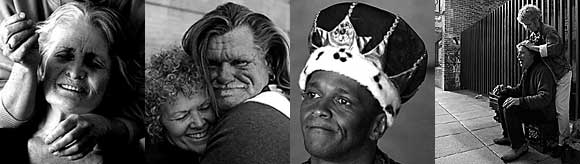
In this month’s issue of InTheFray, we examine some of these struggles to see eye-to-eye with people who can often seem to be a world apart — even when they’re just a few inches away. At home in the United States, Stacy Torian takes a look at the difficulties faced by working class academics, who can lack the resources and pedigrees of their more privileged peers, in “Breaking through the class ceiling.” Former prescription drug addict Alexis Luna, meanwhile, exposes her own struggle to get over “The joy of six milligrams” and to have healthier relationships with people — including herself.

On the subject of illness, Chip Chipman illuminates how the spirit of the legendary uniter and healer, Mother Theresa, lives on after her death. Through his vivid photographs, Chipman reveals Mother Theresa’s impact on San Francisco masseuse Mary Ann Finch, who runs a massage institute for the homeless, in “Touching the untouchables.”

Halfway around the world, two ITF contributors share their struggles to relate to others in the Middle East and Africa. Writing in a time of war, Andrew Blackwell shares the skepticism he felt while producing pro-Western video clips during Afghanistan’s first election in“Democracy, Middle East-style.”

Providing insight on the role everyday practices play in reminding us of what it means to be alive, ITF Contributing Artist Josh Arseneau shares his photographs from the Gambia.

Rounding out this month’s stories is ITF Assistant Managing Editor and Columnist Russell Cobb’s “Go ahead, make my next four years,” an insightful look at the Religious Right’s inability to transform Hollywood’s liberal ways — despite harsh criticism of Clint Eastwood’s Oscar-winning film “Million Dollar Baby.”

Coming later this month: stories celebrating women’s history. And in April, check back for an issue concerning belonging — something we all know about, for better or worse.

Laura Nathan, InTheFray Editor
Brooklyn, New York


Quote of note

“I am concerned that the public may start to wonder: ‘Well what is a journalist and isn’t it all kind of a scam somewhere on the payroll, some seem to work for partisan organizations’ … I fear they may question all of journalism, it’s kind of a con game and a sham and that would be unfortunate.”

Matthew Cooper, Time White House correspondent, speaking about the perception of journalists in the aftermath of the Jeff Gannon scandal.  

Bloggers recently unmasked Jeff Gannon, who had been installed in the White House as a correspondent for a media outlet, as a journalistic fraud; his real name is James Guckert, the ostensibly responsible media outlet for which he reported, Talon News, has been exposed as a Republican mouthpiece and has now been taken offline, and lurid accounts that link Guckert to pornographic websites have now surfaced.  

Bloggers began to research and subsequently expose Guckert after he asked President Bush the leading question that was too transparently partisan to evade scrutiny: “Senate Democratic leaders have painted a very bleak picture of the US economy … How are you going to work with people who seem to have divorced themselves from reality?”

Mimi Hanaoka