Blog


Quote of note

“Prosecuting and imprisoning people for homosexual conduct are flagrant human rights violations…Subjecting the victims to floggings is torture, pure and simple.”

— Scott Long, director of the Gay, Bisexual, and Transgender Rights Program at Human Rights Watch, condemning the recent sentencing by a court in Jeddah, Saudi Arabia, of over 100 men to jail terms and flogging for alleged homosexual conduct.  The men were arrested last month at a private party and, according to a Saudi newspaper, were accused of dancing and “behaving like women.”  

Mimi Hanaoka


Beware the Lavender Menace

But I couldn’t let them do that to me and humiliate me anymore. I couldn’t let them win just because they think it’s their duty to rid the world of lesbians.

Mary Stephens, a women’s basketball coach from a small town in rural Texas,was fired from her position because of her sexual orientation. Parents within the community accused of her of ‘converting’ their daughter and suggested that while they might like her as a person, supporting one lesbian would be tantamount to endorsing a larger homosexual agenda, including gay adoption.

Stephens’ case has been settled out of court and parents in Bloomburg, Texas, can sleep easily at night, knowing that their daughters are safe from the ever dangerous gay missionaries.  But her case demonstrates how effectively the conservative right has coopted the feminist movement’s “personal is political” doctrine.  

Conservatives have effectively positioned individuals as symbolic of and responsible for larger political agendas.  It becomes impossible to support one woman, who coached a small-town team to regional championships — the stuff Hollywood movies and President Bush’s favorite book, are made of — because to do so would be to also support what has been painted as anti-Christian, anti-family, and anti-American.   The only connection existing between a high school basketball coach and gay adoption is one of political punditry. While fear of homosexuals in schools has often been an undercurrent in American education, historically that fear was based more in fears of predation, rather than perceived support of a liberal political agenda.

Seeing people not as individuals but symbols of ideology is a dangerous and limited line of sight.  This is nowhere more evident than in the current political fracas surrounding President Bush’s judicial nominees.  Senator Bill Frist is currently preparing for Justice Sunday, a telecast depicting the Democrats’ threatened filibuster as a campaign against people of faith.  While Senator Frist has previously appealed to the Democrats for compromise, appearing in an evangelical broadcast alongside Chuck Colson and Dr. James Dobson casts a new light on his willingness to promote dialogue.

As a society, we are slowly moving towards an understanding of racial and ethnic identity as multi-hued.  Our understanding of religion, instead, has grown ever more narrow and sharply defined and politically based.  Without a willingness to see individuals within both the “the people of faith” and those outside of that group (The people without faith? The faithless?), we cannot move forward in the Senate, the judiciary, or our communities.

Laura Louison


Cosmic race

Once again, science is shaking up our comfortable notions of race and ethnicity. First, there was that whole flap over whether one of America’s Founding Fathers had a black mistress (DNA tests suggested …

Once again, science is shaking up our comfortable notions of race and ethnicity. First, there was that whole flap over whether one of America’s Founding Fathers had a black mistress (DNA tests suggested he did). Now an article in Wednesday’s New York Times describes an offbeat in-class experiment at Pennsylvania State University. Students in a sociology class agreed to have the insides of their cheeks swabbed in return for a DNA profile that stated — down to the percentage point — how much white, black, Asian, or indigenous American blood flows through their veins. One student, a self-described “proud black man,” was shocked to learn that he is 48 percent white.

It’s interesting to think what would happen if we all took these kinds of DNA tests. How much would it uproot our lives to learn — as many of us probably would — that our bloodlines flow into previously unknown waters?

The fact that we would be surprised by such news is another reminder that race is — as sociologists like to say — “socially constructed.” That is, race has more of a reality in people’s heads than in the makeup of their genes. If you believe yourself to be black and others see you as black, you are black — even if your DNA begs to differ. The racial category of Hispanic or Latino in the United States (the U.S. Census Bureau categorizes it as an “ethnicity”) is another example of social construction. It includes people of widely varying degrees of European, indigenous American, and African ancestry, but somehow has been boiled down to a single, catch-all identity, bound together more by a perception of shared culture than any strict notion of biology. Early 20th-century Mexican writer José Vasconcelos celebrated this mixed identity, heralding the rise of a “cosmic race.”

Just because race is in our heads doesn’t mean it is trivial or that we can just decide tomorrow to forget about it — after all, how people perceive you often dictates the social circles you dwell in, the opportunities you enjoy, and so on. That said, what is constructed can be reconstructed. If there is any hope to ending ethnic hatreds, it may lie in an acknowledgment that round human beings can no longer be fit into square racial categories. It may depend on the emergence on a truly “cosmic” race of individuals no longer tied to the old lies of racial purity.

Victor Tan Chen

Victor Tan Chen is In The Fray's editor in chief and the author of Cut Loose: Jobless and Hopeless in an Unfair Economy. Site: victortanchen.com | Facebook | Twitter: @victortanchen


Quote of note

“The worldwide campaign against terrorism has given Beijing the perfect excuse to crack down harder than ever in Xinjiang. Other Chinese enjoy a growing freedom to worship, but the Uighurs, like the Tibetans, find that their religion is being used as a tool of control.”

— Brad Adams, Human Rights Watch’s Asia Director, speaking about China’s suppression of the ethnic Uighur minority, who live in the oil-soaked northwestern section of the country.

The Uighurs comprise eight million of the 19 million people in the Xinjiang province. They are Turkic Muslims, speak a Turkic dialect — most speak little or no Chinese — and desire a greater level of autonomy from China. Uighurs are now becoming even more of a minority in their home region; largely due to the influx of Chinese Han settlers, the Uighur population in Xinjiang has plummeted from 90 percent in 1949 to 45 percent today.  

Sharon Hom, Human Rights in China executive director, emphasized that the Chinese government is using the war against terror as a guise under which to suppress the Uighurs, who lie on the geographic, linguistic, and cultural fringes of China. “As Islam is perceived as underpinning Uighur ethnic identity, China has taken draconian steps to smother Islam as a means of subordinating Uighur nationalist sentiment,” states Hom.

The repression that she refers to runs the gambit from the scrutinization of imams and mosque closures to detentions and executions.  

Mimi Hanaoka


“Down with Japan”

Chinese protesters — about 10,000 in Beijing and 3,000 at the Japanese consulate in Guangzhou, which is located in the south — marched and chanted to protest a new Japanese history textbook that glosses over Japan’s wartime atrocities that occurred in the 1930s and 1940s. Some of the most notable editorial revisions to Japan’s wartime history include referring to the Nanking Massacre, during which anywhere from 100,000 to 300,000 Chinese civilians were killed by Japanese troops between December of 1937 and March of 1938, as an “incident” and neglecting to mention any numbers of civilians murdered during that massacre, as well as the textbook’s failure to thoroughly explain Japan’s use of Chinese and Korean women as sex slaves, or “comfort women.”

Like an open sore that is constantly chafing against history, the Sino-Japanese rift is constantly being agitated. Prime Minister Junichiro Koizumi’s and other ministers’ repeated visits to Yasukuni shrine, where Japan’s war dead are enshrined — including class A war criminals — are frustrating Japan’s Asian neighbors. The ministers who visit Yasukuni state that they are paying their respects to the Japanese war dead, while many Chinese insist that they are glorifying war criminals, such as General Hideki Tojo, who is enshrined at Yasukuni.

Japan’s revisions of history and refusal, unlike Germany, to apologize for its atrocities perpetrated during the war years, have very concrete ramifications on Japan’s relations with its Asian neighbors. The Chinese are protesting Japan’s bid for a permanent seat on the UN Security Council, and Kim Sam-hoon, South Korean Ambassador to the UN, recently fumed that “a country that does not have the trust of its neighboring countries because of its lack of reflection on the past” cannot fulfill the “role of a world leader.”

Mimi Hanaoka


No longer right

Voter turnout for Italy’s regional elections has surpassed all expectations. And as a result, Italy’s current prime minister Silvio Berlusconi has more to mourn than the passing of Pope John Paul II in the Vatican. While millions of people waited in line to view the Pope, enough Italians went to the polls this past Sunday and Monday to liberate six of the eight governorships previously controlled by Berlusconi’s coalition, the House of Freedoms.

The Economist reported on April 6 that Berlusconi’s recent efforts to attract voter support with tax cuts and promises to bring Italian troops home from Iraq have failed to gather even the support which has granted him the honor of being “the longest-serving Italian leader since the 1922-43 dictatorship of Benito Mussolini.”

Berlusconi’s unpopularity suggests that former President of the European Commission Romano Prodi may have a shot at taking over Italy’s reins. Prodi’s coalition, known as the Union, finds fault with Berlusconi’s unapologetic efforts to increase his personal control over the Italian media and does not support a current reform which aims to strengthen the power of the prime minister and weaken those of the president and the constitutional court.

-Michaele Shapiro


What the Pope means outside the Catholic faith

Joni Mitchell’s words illuminate the passing of Pope John Paul II in a way which we have failed to note on this side of the Atlantic: “You don’t know what you’ve got till it’s gone.” Regardless of how people view Catholicism and religion, the role Karol Wojtyla played in the world over the last decades held such influence that finally, his absence will be felt in ways his presence may not have been.  

Pieces published in the News.Scotsman.com, Allafrica.com, and the Timesonline.co.uk draw attention to the impact this man has had upon the world beyond the religious sphere.

“He was not only for Catholics, but all religions and the world at large,” said Monsignor Sladan Cosic of the Vatican Embassy in Zambia.

Stefan Chwin wrote, in an article translated by Philip Boehm, that while Wojtyla was loved by the Poles for many reasons, they loved him most for “his visible respect for people from all corners of the earth.”

—Michaele Shapiro


The statistics of death

Amnesty International reports today that there were a minimum of 3,797 people who were executed last year in 25 countries; 97 percent of those executions occurred in China, Iran, Vietnam, and America.

In 2004, Bhutan, Greece, Samoa, Senegal, and Turkey joined the list of 115 other nations that have abolished the death penalty.  

Mimi Hanaoka


Outside looking in, inside looking out

issue banner

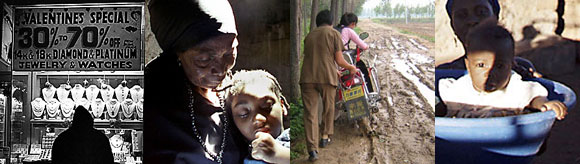
Belonging. It’s one of the most basic human needs, and the price of its absence — exclusion — is both the source of some of our greatest conflicts and, paradoxically, a motivator of change and innovation.

Sure, some of us may be chameleon-like, blending in so as to not stand out. But most of us, no matter what our nationality, struggle to fit in ways both big and small thanks to our beliefs, our gender, our sexual preferences, the color of our skin, age, our accents, physical and mental dispositions, financial circumstances, and family structures, to name just some of our distinguishing characteristics.

In this issue of InTheFray Magazine, we examine what it means to belong — and what it means to be an outsider. To elucidate the global dimensions of this phenomenon, photographer Chika Watanabe shares her photos from some of the world’s most vibrant and prosperous cities — New York, Madrid, and Tokyo — in Envisioning belonging.

Far from these metropolises, Raque Kunz relays how a move to rural Rincon, Cape Verde, demands reconsideration of the importance of family and friends and a new approach to dating in A hard bargain. Meanwhile, in rural Shandong, China, InTheFray Assistant Editor Michelle Chen illuminates how one Chinese teenager’s failure to belong to either the city or the village complicates her struggle to make her way in the world in Homecoming for Hai Rong.

Bringing us back to the skies, streets, and bookshelves of the United States, David A. Zimmerman, in Walk this way, tackles the question of how female comic book characters are faring in what is often thought of as a Superman’s world — and how today’s superheroines are improving humanity, one comic book at a time.

Rounding out this month’s stories is the winning essay from InTheFray’s first annual writing contest. Showing readers how he goes about Respecting life, Bambi-style in a small Minnesota town where killing is the norm, Thomas Lee Boles emphasizes the value of animal — not just human — life. Thanks to everyone who entered the contest this year — we received some great entries and look forward to receiving more next year.

Thanks for reading — and remember all of these dreary April showers are sure to bring May flowers!

Laura Nathan, InTheFray Editor
Brooklyn, New York
