Blog


Racing in Iran

Forcing her Peugeot through the streets of Tehran at 80 kilometers an hour in a 30-kph zone, Laleh Seddigh — 28, indefatigable, and beautiful — is quite literally racing her way to the top of Iran’s car-racing community. Seddigh has been notching a number of firsts: She is the first woman since the Islamic Revolution occurred, in 1979, to compete against her male counterparts in any athletic competition; she is the first Iranian woman to compete against men in car racing; and she was first to cross the finish line during Iran’s national racing championship, which was held in March of this year. Lest her detractors think that she has traded brawn for brains, she has already received her BA and MA from Tehran University, and she is currently working towards her doctorate in industrial management and production.

As one of the 70 percent of Iranians younger than 35, she has a bold confidence and a message that may well be a function of her youthful vitality: “In this society, women don’t believe in themselves … They have to believe in their inside power.”

Mimi Hanaoka


Racist roundup answers!

Answers to the “Racist (and mysogynist!) roundup” quiz:

1. B. The manager said, “Bin Laden is in charge of the kitchen.”

2. A. Miss Jones said to Miss Info, “You feel superior, probably because you’re Asian,” to which Mr. Lynn responded: “I’m gonna start shooting Asians.” The boardgame was “Chinkopoly,” and the song was “We Are the World.”

3. I am sad to say, as someone raised in New Jersey (South Jersey!), the answer is D.

4. A. Star (Troi Torain) called her a “bitch” and a “filthy rat-eater.”

5. D., though the wire service that carries Coulter’s columns, Universal Press Syndicate, eventually edited the column to read: “That dyspeptic, old Helen Thomas.”

Gosh, those racists/mysogynists say the darndest things! Do let me know if you hear about any more hilarious mysogynist/racist/etc. bits of news, in the States or elsewhere — you just can’t get enough of these people! (Did I say “these people”?)

Victor Tan Chen

Victor Tan Chen is In The Fray's editor in chief and the author of Cut Loose: Jobless and Hopeless in an Unfair Economy. Site: victortanchen.com | Facebook | Twitter: @victortanchen


Racist (and misogynist!) roundup

For those who haven’t been keeping abreast of the activities of all the racists and misogynists back in the States (which I would be blissfully ignoring myself, if not for all the action alerts that keep plopping into m…

For those who haven’t been keeping abreast of the activities of all the racists and misogynists back in the States (which I would be blissfully ignoring myself, if not for all the action alerts that keep plopping into my Inbox), here is a handy quiz:

1. In April, seven Arab American men filed a $28 million lawsuit alleging that while they were eating at a Denny’s restaurant in Florida:

A. Their server refused to take any order except “Moons Over My Hammy.”

B. The manager kicked them out and told them, “We don’t serve bin Ladens here.”

C. The restaurant had a sign over its bathroom that said, “No A-rabs allowed.”

D. They waited for over an hour for their food while customers who arrived later were served. After they asked twice about their order, the manager responded: “Saddam Hussein is in charge of the kitchen.”

2. In February, New York radio host Miss Jones returned to Hot 97. She had been suspended from her morning show for:

A. Playing a song that mocked the victims of December’s tsunami and included the lyrics: “There were Africans drowning, little Chinamen swept away / You can hear God laughing, ‘Swim you bitches swim.’”

B. Insulting her Asian American co-host Miss Info by calling her a “screaming chink.” Co-host Todd Lynn added: “God, I hate those Asians.”

C. Telling her listeners to a create their own board game, “Gookopoly,” in protest of the board game “Ghettopoly,” which was created by an Asian immigrant.

D. Singing on the air, to the tune of John Lennon’s “Imagine”: “So now you’re screwed. It’s the tsunami, / You better run and kiss your ass away. Go find your mommy. / I just saw her float by, a tree went through her head. And now your children will be sold. Child slavery.”

3. In April, the hosts of a New Jersey radio show, 101.5 FM’s “The Jersey Guys,” criticized a Korean American candidate in a local Democratic primary, and then said the following:

A. Talking about how ethnic minorities were always asking for special treatment, host Craig Carton said: “And no one gives a damn about us anymore … And if we cry about it, you know what’s brought up? Slavery … or if we cry about it … well you know, ching chong, ching chong [mimics Chinese accent], you bombed us.”

B. After commiserating with a caller about the “damn Orientals and Indians” in New Jersey, Carton remarked, “It’s like you’re a foreigner in your own country, isn’t it?”

C. Complaining that all the poker tables in Atlantic City were crowded with Chinese players, Carton opined: “Well, go to [Atlantic City] for one week and try and get a table …  ching chong, ching chong, ching chong [mimics Chinese accent]. ‘Hehe, you hit it on seventeen, you stupid bitch’ … they got their little beady pocketbooks with the little beads on it. They take out wads of hundreds. Ching chong ching chong [accent].”

D. All of the above.

4. In December, the hosts of the “Star and Buc Wild” morning show on Power 99 in Philadelphia phoned a customer service call center in India and then:

A. Threatened to “choke” the customer service representative.

B. Called her a “cow-worshipping bitch.”

C. Called her “filthy monkey-eater.”

D. All of the above.

5. Political commentator Ann Coulter sparked protests in March when she insulted Helen Thomas, a columnist who has worked as a White House correspondent for more than 60 years. What did she call Thomas?

A. “That dyspeptic Arab Helen Thomas.”

B. “That clueless Arab liberal, Helen Thomas.”

C. “That Arab I’d like to shoot, Helen Thomas.”

D. “That old Arab Helen Thomas.”

You can view the answers by clicking here.

Victor Tan Chen

Victor Tan Chen is In The Fray's editor in chief and the author of Cut Loose: Jobless and Hopeless in an Unfair Economy. Site: victortanchen.com | Facebook | Twitter: @victortanchen


Sex on the brain

Swedish researchers have, using brain-imaging techniques, concluded that gay men and straight men respond differently to two different scents that are potentially involved in sexual arousal.  So what does all this sex on the brain mean? Firstly, it may give credence to the notion that humans, like animals, may have pheromones, which are chemicals that invite certain types of behavior, such as sexuality, within a species; secondly, this data may prompt researchers to consider the biological and chemical foundations of sexuality and sexual preference.

The study, however, should only be seen as a beginning and certainly not as proof that there is a biological explanation for sexual orientation and behavior; it is still unclear whether it is sexual behavior that transforms brain chemistry or whether it is the brain chemistry that dictates sexual preference.  Furthermore, Dr. Ivanka Savic of the Karolinska Institute in Stockholm, who headed the study, issued the curiously vague comment that while the subjects in her research included gay women, the results of that aspect of the study were “somewhat complicated” and therefore cannot yet be published. We should, then, cautiously understand this study only as a foray into the biological causes and effects of sexuality and as a door that is beginning to be opened, but not as a definitive statement about sexuality or sexual behavior and orientation.

Mimi Hanaoka


Quote of note

“Freedom to kill is not a true freedom, but a tyranny that reduces the human being into slavery.”

— Pope Benedict XVI at the basilica of St. John’s in Lateran during his installation as the Bishop of Rome, speaking about this “unequivocal” condemnation of abortion and euthanasia.  The 265th Pope has already earned the moniker “God’s Rottweiler” for his unrelenting and inflexible conservatism.

Mimi Hanaoka


The ID with no borders

The so-called Real ID Act , which passed in both congressional houses last Thursday, states that DMVs can only issue national driver’s licenses to qualifying applicants who prove their legal presence in the U.S. and furnish a valid social security number.  

As expected, the act has roused debate throughout the nation, with one side vouching for the “Real IDs” promise to fortify national security, and the other side decrying the act’s oblique “infringements on civil liberty,” its requirement of extra personal documents to “prequalify” applicants for driver’s licenses. Detractors (many of whom are ACLU affiliates) also argue that the act does not target potential foreign terrorists on overstayed Visas as thought, but will intimidate harmless illegal residents, who will forego important driver’s training and licensing procedures for fear of being caught and deported.  

Toyin Adeyemi


Out with evolution

“Evolution is a great theory, but it is flawed … There are alternatives. Children need to hear them. We can’t ignore that our nation is based on Christianity — not science.”

— Kathy Martin, 59, a member of Kansas’s state board of education and a former science and elementary school teacher, who is presiding over the board’s recent inquiry into the role that evolution should play in the science curriculum of the Kansas public schools. Martin, who makes no attempt to hide her religious affiliation, has found many like-minded individuals, and Kansas is not the only state engaged in the debate over the legitimacy of teaching evolution; Ohio has already passed a measure guaranteeing that teachers may, in their classes, challenge the theory of evolution. Far from adhering to the notion of the separation of church and state, Martin and those who are on her intellectual and spiritual horizon are aggressively, legally, and insistently wedging the presence of the church in the ostensibly secular state.

Mimi Hanaoka


What it means to miss New Orleans

New Orleans. Mid-descent to Los Angeles, sinking through the layer of smog to reveal houses swimming in asphalt below us, it seemed as though we had been gone for a year instead of four days at Jazz Fest.

New Orleans is a city I loved entire before I ever walked its pot-holed streets, but for the first 27 years of my life, I was ignorant of its existence. The friends I knew who had ventured to the Crescent City returned with tales of oppressive humidity which far outweighed any of its considerable charms.

Just before April 2003, Taylor Hackford was ready to shoot his magnum opus based on the life of Ray Charles in New Orleans, and my boyfriend Anthony was hired for the job. He had found an apartment in the Garden District when I finished the job I had been working on. Ever the traveler, I made plans to escape the insanity of the film industry by hiding out for a month in his apartment at the intersection of Coliseum and Louisiana, dreaming awake in a place I’d never been before.  

Love descended suddenly. The muggy air was an anchor; the heat beat down. There’s a saying in Italy that to truly love, you must fall in love with a person’s faults. The heat was as enchanting as it was oppressive.

One moment I wouldn’t have noticed if New Orleans had been swallowed by a hurricane, while the next found me shaping my life around its tendrils and vines. As New Orleans resident Andrei Codrescu writes in a piece entitled “Secrets” in Zombification, one of his collections of essays written for NPR, “[T]he fact is that we all know that there exists in the world an order different from that in which we pass our days.”

Perhaps some of the transfixing beauty of New Orleans lies in its distance from the stress of life in Los Angeles. In its awareness of its own identity; in its seductive determination to watch the rat race from afar, without designs to follow the trend of velocity.

—Michaele Shapiro


Ugly children

If we’d smugly thought — or hoped — society had progressed beyond superficiality, we were, apparently, dead wrong; a study out of the University of Alberta claims that parents are culprits of a strangely intuitive but menacing type of favoritism — parents treat attractive children better than they treat ugly children.

The team of researchers at the University of Alberta, led by Dr. W. Andrew Harrell, head of the university’s Population Research Laboratory, scattered themselves across 14 supermarkets, of all places, and then observed over 400 interactions between parents and their children. Having rated the child’s attractiveness on a scale of 1 to 10, the researchers used the following as some of the criteria for how a parent treated his or her child: whether the parents safely belted the child into the seat of the grocery cart, whether the parents’ attention waned or lost focus, and whether the parents permissively or absent mindedly allowed the child to wander away or frolic dangerously in the grocery store. The results of the study — although, to be fair, the findings have yet to be published, so the academic community has not yet had sufficient time to pass judgment on Harrell’s claims — point to the creepy conclusion that parents take markedly better care of attractive children over their less attractive peers.

Harrell, who led the search, insists that, “like lots of animals, we tend to parcel out our resources on the basis of value … Maybe we can’t always articulate that, but in fact we do it. There are a lot of things that make a person more valuable, and physical attractiveness may be one of them.” The treatment of the child, according to Harrell, can be reduced to tendencies that make evolutionary sense, with attractive children and their attractive genes meriting more care.

While academics have not yet had time to sink their teeth into Harrell’s argument, some have already dismissed the study. Robert Sternberg, a psychology and education professor at Yale, pooh-poohed Harrell’s methodology — such as ignoring the socio-economic status of the parents and children who were observed — and dismissed the evolutionary theory as “speculative.”

Regardless of whether Harrell’s theory carries any scientific or intellectual legitimacy and parents do, in fact, enter into some sort of bankrupt aesthetic calculus when deciding how to treat their children, we can at least know that beauty is in the eye of the beholder, and not least in the eyes of the researchers.  

Mimi Hanaoka


Imbibing

issue banner

If April is the cruelest month, then May deserves a stiff drink. But before you reach for that new Australian Shiraz, consider the mood-altering moments you are already soaking in.

Our overall environment, for instance, may be the most overlooked drug. Who hasn’t been transported by a sunset on the beach, felt their brain chemicals paralyzed by a stressful day of work, or developed a different understanding of reality by hanging with a different crowd?

In this issue of InTheFray, we explore the impact of environment in its many forms. We begin on the streets of Brooklyn, home to a pool hall frequented by a diverse mix of teenage boys. While Contributing Editor Anju Mary Paul tries to put her thumb on what being American means for young immigrants in 2005, Through the Looking Glass writer Kristina Alda writes from our northern neighbor, Canada, about her transformation into a typical Canadian “nice girl” after adopting Ottawa as home.

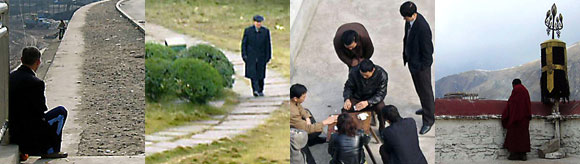
Of course, home can be a complicated place. For some, it’s simultaneously safe and oppressive, straining and joyful. For a wife who becomes caregiver to her husband after an accident, in Susan Parker’s short story Taking care of one another, it is exhausting. For Kelly Barnhill it is a place of warring priorities. Her essay A room of my own with the door wide open, details how becoming a new mother leaves little time to write. And on the Yangtze River in the small town of Wanzhou, where photographer J. Unrau lives, home is intoxicating. As his photo essay illuminates, the daily sounds and smells he absorbs while wandering the hilly streets are his drug of choice.

So imbibe with us, and expand your mind, by sampling our stories all the way from small town China to a Brooklyn pool hall.

And get ready to imbibe a little more this June, when ITF celebrates gay pride month. As part of our celebration, InTheFray would like to showcase photographs of LGBT celebrations and events happening around the United States and the world. Readers can submit original photographs to our Media Gallery, where they will be posted daily. InTheFray asks that you provide a brief caption to be published with the photograph, telling us the who, what, when, and where of your photo(s). Please also include your first name and location.

(A note to our readers: Please complete our 2005 Reader Survey. Your answers will help us to improve the magazine.)

Nicole Leistikow
Managing Editor
Baltimore