- Follow us on Twitter: @inthefray
- Comment on stories or like us on Facebook
- Subscribe to our free email newsletter
- Send us your writing, photography, or artwork
- Republish our Creative Commons-licensed content


This issue of InTheFray explores the complexity of cultural change and the unpredictable outcomes that evolve when one way of life challenges another. This month, we explore the loss, liberation, conflict, and carnival that can ensue when old and new collide.
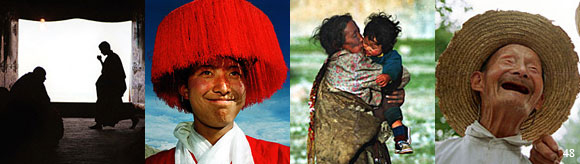
We start with the bad news. Modernization and assimilation often sound the death-knell for under-resourced minority groups. Pulitzer Prize-winning photographer John Kaplan documents the fast fading indigenous cultures of China, Bolivia, and Thailand in Vanishing heritage.
Yet some old traditions die hard. Irene Kai’s The Golden Mountain chronicles four generations of Chinese women escaping the yoke of submission. In her review of the memoir, Always know your place, and in her interview with the author, Old traditions die hard, ITF Culture Editor Laura Madeline Wiseman explores both the limitations of a victim’s viewpoint and the liberation that comes of writing about suffering.
Former Peace Corps Volunteer Kathryn Brierley, in her essay Reflections on a new democracy, also shows that change comes slowly. Ten years after the end of apartheid, the writer encountered a South Africa that still bears many scars.
The good news, however, is that change can sometimes bring inspiration. In Girls just want to have fun, ITF Travel Editor Anju Mary Paul‘s second story on young Muslim women in the United States, innovative teenagers plan and execute an all-girls prom, joining in an American tradition, Muslim style. If only change were always reason for a party.
Meanwhile, here at ITF, we’re sure to inspire your inner media critic with our latest addition: weekly TV, film, and DVD reviews available only in our PULSE Web log.
Nicole Leistikow
Managing Editor
Baltimore, Maryland
Coming Up
In December: ITF publishes its 50th issue. To celebrate, we’ll highlight the best of the magazine so far — and introduce some new perks. Take a minute to vote for your favorite ITF stories from the past.
“What’s important is that she’s a person made by God, loved by God and given gifts by God who feels that she’s called to be a priest, and that’s a call that’s been checked out by the church rigorously … Gender realignment surgery helps address that issue, and it’s about bringing mind and body into wholeness. I see this as something restorative and healing.”
— Bishop of Hereford Right Reverend Anthony Priddis, speaking about the recent ordination of Sarah Jones, 44, as a priest in the Church of England.
British law and the National Health Service recognizes gender dysphoria, in which an individual believes that his or her gender identity is incongruent with his or her anatomical sex. Sara Jones underwent sexual reassignment surgery at the age of 29 to become a woman.
What you allowed to happen happened. Trends were accepted. Leadership failed to provide clear guidance so we just developed it. They wanted intel. As long as no PUCs [“persons under control,” i.e., detainees] came up dead it happened. We heard rumors of PUCs dying so we were careful. We kept it to broken arms and legs and shit. If a leg was broken you call the PA — the physician’s assistant — and told him the PUC got hurt when he was taken. He would get Motrin [a pain reliever] and maybe a sling, but no cast or medical treatment…. People would just volunteer just to get their frustrations out. We had guys from all over the base just come to guard PUCs so they could fuck them up. Broken bones didn’t happen too often, maybe every other week. The PA would overlook it. I am sure they knew.
—U.S. Army sergeant, 82nd Airborne Division
Human Rights Watch (HRW) came out with a new report this week that presents graphic accounts of torture by U.S. troops stationed in Iraq. It is a must-read for anyone who wants to understand the extent of the prisoner abuse problems afflicting an overextended U.S. military, and the damage that poor leadership has caused to the Iraq war effort. The report features interviews with two sergeants and one officer stationed at a base in central Iraq who said they witnessed the torture of Iraqi prisoners — torture that was ordered, the soldiers said, by their superiors and by intelligence officers. The practice was so common that soldiers had developed a lingo for it, the report says: “‘Fucking a PUC’ referred to beating a detainee, while ‘Smoking a PUC’ referred to forced physical exertion sometimes to the point of unconsciousness.”
One factor that encouraged prisoner abuse was that the soldiers guarding a detainee were often the very ones who had been shot at by that detainee hours before — contrary to the military’s own policy, which states that prisoners should be placed in the custody of military police far from the frontlines. Not surprisingly, soldiers put in these situations would go beyond the need to collect intelligence and start collecting their pound of flesh. A sergeant described one such incident of retribution:
We had these new high-speed trailer showers. One guy was the cleaner. He was an Iraqi contractor working on base. We were taking pretty accurate mortar fire and rockets and we were getting nervous. Well one day we found him with a GPS receiver and he is like calling in strikes on us! What the fuck!? We took him but we are pissed because he stabbed us in the back. So we gave him the treatment. We got on him with the jugs and doused him and smoked and fucked him.
Meanwhile, the Bush administration’s denials that the Geneva Conventions apply to its war on terror have created a kind of moral havoc within the ranks. Before the invasion of Afghanistan, U.S. soldiers were trained to avoid torture, period. In fact, the Army’s own Field Manual 34-52 on Intelligence Interrogation states explicitly that the use of force is not an effective interrogation tool: “Experience indicates that the use of force is not necessary to gain the cooperation of sources for interrogation. Therefore, the use of force is a poor technique, as it yields unreliable results, may damage subsequent collection efforts, and can induce the source to say whatever he thinks the interrogator wants to hear.” In today’s military, however, soldiers guarding detainees no longer have clear rules for deciding what is permitted and what is not. They are simply told that they must extract information and that their actions must be “humane” — a dangerously vague standard. “Well, what does humane mean?” said an officer. “To me humane means I can kind of play with your mind … To [another officer I spoke with] humane means it’s okay to rough someone up and do physical harm … We’ve got people with different views of what humane means and there’s no Army statement that says this is the standard for humane treatment for prisoners.”
When stories of prisoners being humiliated and beaten at the Abu Ghraib prison became public, terrorists trying to sabotage the U.S. military in Iraq suddenly had a perfect recruiting tool: concrete evidence of the evil of the American occupation. Now there is reason to believe these abuses are more widespread than first thought, and not just the actions of “rogue” soldiers. In fact, soldiers at one base told an officer that they had taken Abu Ghraib-like photographs but burned them once the Abu Ghraib guards started “getting in trouble for the same things we were told to do.” “It’s unjust to hold only lower-ranking soldiers accountable for something that is so clearly, at a minimum, an officer corps problems, and probably a combination with the executive branch of government,” said the officer.
Did the abuse halt after the media broke the Abu Ghraib scandal? Things “toned down,” said the sergeant, who was interviewed between July and August 2005. “We still did it but we were careful. It is still going on now the same way, I am sure. Maybe not as blatant but it is how we do things.”
The irony is that in torturing detainees with the goal of stamping out the insurgency, the U.S. military has driven even more Iraqis to the cause of the insurgency. That connection was quite clear to one of the sergeants interviewed:
If a PUC cooperated Intel would tell us that he was allowed to sleep or got extra food. If he felt the PUC was lying he told us he doesn’t get any fucking sleep and gets no food except maybe crackers. And he tells us to smoke him. [Intel] would tell the lieutenant that he had to smoke the prisoners and that is what we were told to do. No sleep, water, and just crackers. That’s it. The point of doing all this was to get them ready for interrogation. [The intelligence officer] said he wanted the PUCs so fatigued, so smoked, so demoralized that they want to cooperate. But half of these guys got released because they didn’t do nothing. We sent them back to Fallujah. But if he’s a good guy, you know, now he’s a bad guy because of the way we treated him.
As the officer interviewed in the HRW report makes clear, the abuses he saw were not perpetrated by “dishonorable” individuals. These were courageous soldiers who also happened to be human, he said. They were being put in charge of people who might have tried to kill them or their friends. At a minimum, they deserved leaders who could set clear boundaries and accept responsibility for what happened. The fact that they have not received such leadership has jeopardized America’s mission in Iraq, both morally and practically:
We’re mounting a counter-insurgency campaign, and if we have widespread violations of the Geneva Conventions, that seriously undermines our ability to win the hearts and minds of the Muslim world…. [I]f America holds something as the moral standard, it should be unacceptable for us as a people to change that moral standard based on fear. The measure of a person or a people’s character is not what they do when everything is comfortable. It’s what they do in an extremely trying and difficult situation, and if we want to claim that these are our ideals and our values we need to hold to them no matter how dark the situation.
Victor Tan Chen Victor Tan Chen is In The Fray's editor in chief and the author of Cut Loose: Jobless and Hopeless in an Unfair Economy. Site: victortanchen.com | Facebook | Twitter: @victortanchen
The karma of creativity in TV land works in mysterious ways, thus the abundance of alien, psychic, and in-search-of shows to hit the networks beginning last season and continuing this fall. If you’re the type of viewer who liked Twin Peaks and the X Files, then you’ll be a happy couch potato camper with shows such as Lost, Medium, Invasions, and Threshold invading the airwaves this season.
The buzz is in abundance for the hit show Lost (Wednesday at 9 p.m., ABC), and with recent Emmy Award wins it is sure to keep up the momentum, at least for another season. What Lost has going for it is a great cast and a nice blend of action, mystery, intrigue, and human drama. The problem with shows that have a continuing mystery as part of the fabric of the show is the need to sustain a level of anxiousness while always revealing secrets to satisfy viewers and keep the storylines in perpetual motion. The X Files was successful because it would pepper the central storyline of FBI agent Mulder’s search for evidence of his sister’s alien abduction with stand-alone episodes that explored other bizarre paranormal experiences while retaining the core human relationship between the leads. Lost has such a large cast and so many storylines that it will be difficult to keep it going for multiple seasons without becoming a parody of itself or getting so “inside” (like Twin Peaks in its second season) that audiences get turned off and leave in droves.
Another sophomore show is Medium (Monday at 10 p.m., NBC), starring Emmy-winner Patricia Arquette, that is half cop show, half family show and half paranormal show. Aha, you say, that adds up to 150 percent. You are correct and that’s the problem. Medium is very adept at depicting a middle American family; it has all the elements that make a cop show interesting; and it portrays the psychic ability of the main character in a believable manner, but those are too many things to pack into one show. If they would drop one of the three — family, psychic, or cop procedural — then I think they’d have a decent series, but at this point, there isn’t enough of either to keep me coming back week after week.
Two alien invasion shows have landed dramatically this season, and both contain great casts, excellent production values, and mystery storylines. The better of the two, Threshold (Friday at 9 p.m., CBS), had a two-hour premier that instantly grabbed you as it introduced the members of a secret government cabal headed by the Deputy National Security Advisor, played by the accomplished Charles S. Dutton. After a cargo ship appears to have been attacked by an alien craft, an elite group of specialists called The Red Team are brought together to check out the strange goings on. Headed by the attractive Carla Gugino (Karen Sisco), portraying a worst-case-scenario expert whose worst case happens to be alien invasions, the group consists of individuals with a distinct expertise and personality that makes each character, and their interactions, very watchable, much in the vein of the Star Trek franchises.
Speaking of Trek, the superb supporting cast has Brent Spiner (Data in ST: Next Generation) as a forensic microbiologist, Peter Dinklage (The Station Agent) as a womanizing mathematician and linguist, Rob Benedict (Felicity) as an astronautical engineer, and the resident commando, Brian Van Holt (Black Hawk Down) who keeps them all out of harm’s way. What I like so far about Threshold is that it seems proud of its intelligence and the way it portrays the science by only explaining things when needed and in a seamless, organic manner, much like the characters in ER banter medical jargon. I hope that the series doesn’t pander to network executives wanting to sex things up and that they let the geeks of the world word-of-mouth it to success. If not, it can have another life as a feature film (see Serenity).
The other alien show is Invasion (Wednesday at 10 p.m., ABC), where presumably aliens have infiltrated a small South Florida town after a large hurricane blows through. It is Invasion of the Body Snatchers for the 21st century. A lot of critics have been raving about this show, touting its high production values and superb cast, but the premier didn’t impress me, and succeeding episodes haven’t gotten much better. They have successfully set up all the players and their dynamics, but I just wasn’t blown away. I saw no signs that the show would explore any new territory in the aliens taking over the world storyline and certainly not better than how Threshold is tackling the premise. Only time will tell if Invasion can keep the big lead it inherits from Lost.
Another new show that should be included with this group is The Night Stalker, a reimagination of the 70’s TV movies and show that started this whole genre. Since it was a favorite of mine as a kid, I want to savor the new version over time and weigh in later on whether it lives up to its predecessor.
As they say, stay tuned.
Lost: Must See.
Medium: Pass.
Threshold: Must See.
Invasion: Wait & See.
“The general image of the Arab woman is that she isn’t happy…Well, we’re all pretty happy.”
Karen Hughes, under secretary of state for public diplomacy, was confronted yesterday by an audience of educated Arab women who don’t want to be “liberated” by the Bush administration. Hughes suggested in her remarks that Saudi women should be allowed to drive and fully participate in their country. Audience members drawn from the student body of Dar Al-Hekma (a liberal institution) rejected her remarks as disconnected from their personal experience, suggesting that the Bush administration’s negative image in the Arab world may present an obstacle to needed dialogue about civil participation and women’s rights in the region.
In my second year of college, I missed high school. What I missed was the band hall. I reminisced about my best friend flirting with her longtime girlfriend, my sly realist poking at my idealistic bubble, or the gaggle of people that floated around us in our aura of support. We had created a gay-straight alliance without meetings. Soon, we were interrupted by college, and I lost my community.
I spent the next year lost in the swarms. Bright lights lit up every word. Queer Straight Alliance! College Democrats! Ordinary Women! Nothing felt right. I had spent my community on the promises of a brighter tomorrow, only to go broke. As a gay man, the gay community that I depended on in high school now relied on rumors and booze. The more I stayed in college, the more I longed for high school. We had a vocabulary problem. My definition of queer meant support, community, and coffee. To me, their definition meant sex, gossip, booze. I could not rectify those differences. I struggled against my own idealism, fearing that I had run out of steam. Then, Google happened.
On a misplaced remark, I discovered the Gay Greek. Twenty minutes on the Internet, too much enthusiasm, and a national election later, Delta Lambda Phi at Kansas State University gave birth — to me and my brothers. That moment could not have come any sooner. Three months later, I tripped into near suicidal depression.
Spring of 2005, I spent most of March and April locked in my house. If I left, I found myself puking randomly or being so nervous while driving I had to pull over while my anxiety attack subsided. I barely resembled the founding president from a few months earlier. I slept twelve hours a day for weeks. I stopped seeing my therapist. The medical community was for refills or medicating the side effects. The only constant in my life, and what eventually pulled me through, was my fraternity brothers — The Delta Lambda Phi boys.
My fraternity brothers watched over me while I played Russian roulette with psychotropic medications. They empathized as I cried during Duracell commercials, and I beat up myself up over being so fragile. Emerging with Effexor, I could find myself again underneath the battle scars of medication with the community that I had hoped to find but instead was privileged to build.
For those who have been vaguely enticed by Christianity but can’t be bothered to read the tome that is the Bible, there’s hope and a new gimmick on the market; Reverend Michael Hinton has, after years of toil and vicious editing, edited and published the new 100-Minute Bible. Miniature both in content and in style, 11,000 copies of the notebook sized Bible will be distributed to British churches and schools.
The Bishop of Jarrow, Rev John Pritchard, served as a consultant on the book and offered a rigorously non-theological take on the 100-Minute Bible, in which all 66 books of the Christian holy text have been condensed like a literary cheat sheet. “This is an attempt to say, ‘Look, there’s a great story here – let’s get into it and let’s not get put off by the things that are going to be the sub-plot. Let’s give you the big plot’,” was the Reverend’s sunny outlook.
Indeed, it is precisely the “big plot,” of the Bible — its nuances, its theological distinctions, and its literary, historical, and sacred characteristics — that such an attempt at abridgement destroys. And Mr. Pritchard should know better.


A bikinied Barbie doll might send shivers of loathing down a pious Muslim Damascene parent’s spine, but apparently Fulla, a doll that is curiously and impossibly proportioned like Barbie but imbued with “Muslim values,” is sending parents scurrying to the toy stores.
There have been other dolls garbed in traditional Islamic attire, including an Iranian Sara (who is veiled), an American Razanne, and an absurd Orientalist fantasy of a doll called Leila (who is Moroccan) that Mattel, Barbie’s creator, peddled as a slave girl flitting around an Ottoman court. But this new Fulla stands out because people are actually buying her in countries such as Jordan, Egypt, Qatar, and Syria (where she was spawned), even with her hefty price tag of 16 U.S. dollars, when the average Syrian per capita income is about 100 U.S. dollars a month.
Fawaz Abidin, Fulla’s brand manager for her creator, NewBoy Design Studio, explains Fulla’s popularity by insisting that “this isn’t just about putting the hijab on a Barbie doll…You have to create a character that parents and children will want to relate to. Our advertising is full of positive messages about Fulla’s character. She’s honest, loving, and caring, and she respects her father and mother.”
The emotional and spiritual qualifications of a plastic doll aside, the interesting aspect of Fulla is whether, how, and to what extent she will affect attitudes towards the hijab, the popularity of which she may popularize and work to solidify for a younger generation.
The hijab most recently drew international attention with the head scarf bans in France and regions of Germany and the attendant movements that formed to guard the rights of women to wear Islamic garb.