Blog


Great buzz for Bee Season

Each fall brings out emotional, character-driven, intelligent films that producers hope will garner an Academy Award nomination or two.  Fox Searchlight’s Bee Season is one of those films — an American family in trouble story to be compared to Best Picture Oscar winner Ordinary People and the critically-acclaimed The Ice Storm.

Based on the critically-acclaimed novel by Myla Goldberg, Bee Season uses a backdrop of local and national spelling bee competitions to dissect an American family fraying at the fringes but held together just enough by the strong bonds of love.  Throw into the mix heady subjects like personal spirituality, identity, and mental illness, and you have a story about washing away normalcy to reveal dysfunction in a very functional way.

Taking on duo directing duties, Scot McGehee and David Siegel (The Deep End) continue their adeptness at visualizing visceral and hypothetical ideas such as the calculating images explaining the Judaic concepts of Kaballah that are important metaphors in the film.  I also admire screenwriter Naomi Foner Gyllenhaal, mother to actors Maggie (The Secretary) and Jake (Jarhead), for using a family dynamic to illustrate the idea that we humans are always trying to obtain perfection in an imperfect world and that happiness is only realized upon figuring out that life’s goals should only be to love and be loved.

The wonderful cast all seem to embody these blemished characters like wet suits, giving pitch-perfect performances deserving of award nominations.  Richard Gere, probably the weakest of the leads, does give his character of Saul Naumann just enough flawed nuances to make him just this side of normal, yet they’re enough to alienate him from his family.  Julliette Binoche gives another solid bit of acting, portraying a woman whose motherly armor slowly disintegrates, revealing unspoken truths that have taken a toll on her psyche.  The newcomer, Flora Cross, who plays the daughter with the uncanny knack for spelling obscure words, underplays beautifully what could have been a too-charming, pre-teen performance.  Her Eliza continues her bee-winning quest even as the pillars holding up her family slowly crumble around her; yet she dodges the falling debris quite bravely.  But the most satisfying performance goes to Max Minghella, son of director Anthony Minghella (The English Patient), who has the difficult task of playing the angsty teenager trying to find his place in a world that is his own.  Without over-dramatics, he deftly gives us a dry, emotional picture of a teenager tackling the muddy waters of a post-modern coming of age.  As with all the characters, Minghella’s Aaron tries to find balance between individualism and family life, spiritual exploration and traditional thinking that can bring peace to one’s soul.  Peace seems to come from knowing that love can exist within a family that sticks together even if each member isn’t perfect.

Gyllenhaal wanted to write the kind of movie you leave the theater dying to talk about, and I think she succeeded.  Perhaps we all should leave thinking that, even with our emotional dents and imperfect personas, the most powerful energy in the universe revolves around our love for each other.

Bee Season is a unique, psychological, philosophical, emotional, and entertaining visual experience not to be overlooked now and next February.  Kudos also goes to composer Peter Nashel, whose score captures the emotional core of a film in a way that has not been heard since Thomas Newman’s infectious music for American Beauty.  Bee Season opens Friday, November 11th in select cities and nationwide later this month.

Rich Burlingham


The Medicare mess

November 15 marks the opening date for seniors to register for “Part D” of Medicare, the prescription drug plan. People over 65 who receive Medicare will have the choice to register for one of many prescription drug plans, all of which will offer some discounts on their medicine. Sounds great, right? America’s elderly population will no longer have to board buses en masse and travel to Canada to get their prescriptions filled or cut their heart medication in half to make their prescriptions last. Medicare represents a step towards federal responsibility for the huge disparity in health care among America’s citizens — not so fast.

As enrollment begins next Tuesday, prescription drug companies will begin slashing their charitable drug programs. Seniors who once qualified for free medications from pharmaceutical companies will now find that they have to pay for their prescriptions. This wouldn’t seem like such a negative event if Medicare would assume the medication cost. But Medicare’s prescription drug plans will not assist seniors whose prescription drugs cost between $2,251 and $5,100 annually; instead, it will offer them discounts on the money they spend in a lower price bracket and leave them responsible to shoulder co-pays that could approach $3,600.

While Medicare may offer savings to some seniors, enrolling in a prescription drug program remains a bureaucratic nightmare. Insurance companies, eager to cash in on a new market, have flooded seniors’ mailboxes with promotional materials. Not all medications are covered by all insurance plans, so seniors will have to pick and choose plans based on the medications they are currently prescribed — and they’ll have to use the Internet to do it.  As of today, the government has not made any provisions for helping seniors without Internet access or skills access the complex formularies that can identify the best plan for their needs.

This leaves the responsibility to non-profits and individuals, just as the Bush administration would like it. If you know a senior, please help him or her access the site and make some sense of this nonsensical program. And while you’re at it, write your senator a letter. Programs designed to address health equity shouldn’t depend on technology access or equality.

Laura Louison


Quote of note

“The administration is setting a dangerous example for the world when it claims that spy agencies are above the law… Congress should reject this proposal outright. Otherwise, the United States will have no standing to demand humane treatment if an American falls into the hands of foreign intelligence services.”

Tom Malinowski, Washington director of Human Rights Watch, condemning the recent proposal for a presidential waiver for a measure — approved only earlier this month — that would forbid the CIA and U.S. military for using “cruel, inhumane, or degrading treatment” on any detained individual, regardless of his or her location.

The waiver would exempt non-military counterterrorism operations abroad against foreign citizens from the earlier prohibition against “cruel, inhumane, or degrading treatment.” This is not to say that torture doesn’t routinely occur around the world under government auspices; however, the U.S. would be breaking new ground if it creates a legal justification for something approaching torture. The repercussions of such an allowance, Malinowski warns, would be to fling open the doors to outright torture.

Mimi Hanaoka


Jesus, ghosts, and goblins

One of the best possible uses of a lousy movie comes from enjoying the tangents your brain makes to avoid smothering boredom. The Australian existential slasher movie, Lost Things, has all the intellectual overkill and execution underwhelm of a D+ student art film.  Essentially Groundhog Day meets Friday the 13th, the movie centers around horny teens caught in a loop of repeating their last day on Earth that starts over once they realize that they’ve already been murdered. As I said, the movie itself was less interesting to me than the idea that, beneath the surface coherence of our belief systems (e.g., Christian, Muslim, etc.), we adopt passively syncretic worldviews.  Watching Lost Things, I started to think about that fact that, despite all our culture’s putative religious fundamentalism, some people have an uncanny ability to incorporate beliefs seemingly at odds with their core values.

Of course Christianity is famous for this, borrowing traditions while burying cultures.  The Catholic Church was particularly adept at the brutal barter, slaughtering local gods but doling out a few Saints in exchange.  We have Easter eggs, Christmas trees, and an erroneous birthday for baby Jesus in part because, in absorbing paganism, Christianity kept a few of the nicer dresses for special occasions.    

It’s interesting to watch these cobbled beliefs play out on television.  Jennifer Love Hewitt talks to the dearly departed on Ghost Whisperer, a popular series in which she sorts out the problem-ridden world of the dead, where petty souls skulk around Starbucks waiting for supernatural waifs to listen to their bitching.  This dovetails nicely with The Medium where Patricia Arquette receives corpse communiqués in her dreams from people pissed off the police can’t solve their murders.  The only untapped entertainment angle would have to be a show about the backstabbing, sexually charged adolescents who party and betray each other in purgatory.  

If these dramatizations aren’t enough to quench your desire to shoot the breeze with the undead, then there’s always Jonathon Edwards whose carnie-in-chinos routine allows audience members to believe that relatives from the other side, speaking in muffled voices, have nothing to offer other than clichés and treasure map hints about sacked-away valuables.

I’m amused by this because, for a culture with so many religious purists, this seems to be an odd assortment of views to hold simultaneously.  Where in the ideology of heaven and hell are ghosts?  Why do these spirits skid past their life deadline only to fret and obsess over the details of the past?  Can the afterlife be this boring?  When did we start stealing from Buddhism so shamelessly?  Part of my sarcastic tone comes from living in Texas, where people with absolutely no understanding of their own religious texts, history, or theology seek to impose their moral order with the sort of ferocity that only people who have no idea what they’re talking about can muster.  Next time a fundamentalist Christian talks about ghosts, you should ask them if that’s their religion or just static cling.


Far from home

issue banner

With time off of work and school lurking around the corner, many of us look forward to visiting exotic destinations and escaping the seemingly oppressive routine of daily life. But as the stories in this month’s issue of InTheFray suggest, the grass isn’t always greener across the pond.

We begin with John Liebhardt’s exploration of what happens when young men journey to the big city in Burkina Faso in hopes of finding good work and accumulating wealth. The water pushers he profiles in A drop in the bucket find that simply getting a hand on a rung of the ladder requires innovative thinking and a great deal of persuasion.

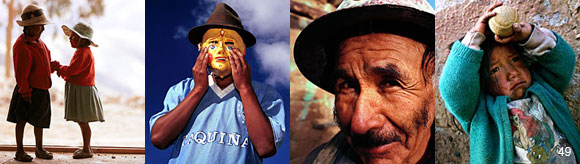
Meanwhile, in part two of his photo essay Vanishing heritage, Pulitzer Prize winner and ITF Advisory Board member John Kaplan documents the indigenous traditions of the Tibetan, Aymara, and Akha peoples even as immigration and industrialization threaten their disappearance.

Even in the imagination, there’s no going back to a place of sufficiency. In her pair of poems Marissa Ranello contemplates the way hunger and need transform us. And Katharine Tillman explores who bears responibility for our lost innocence in Land of enchantment, her tale of a teenager who runs away to be with her boyfriend, only to wind up pregnant, broke, and more alone than ever.

On a lighter note, ITF Contributing Writer Ayah-Victoria McKhail struggles to fit in on a Spanish nude beach, where she ultimately decides that her native Toronto’s beaches, dirty as they may be, might better accommodate her penchant for clothing.

Finally, be sure to check back on Monday, November 21, when JDGuilford unravels age-old myths about gay black men in his review of Keith Boykin’s Beyond the Down Low: Sex, Lies, and Denial in Black America, and ITF Contributing Writer Emily Alpert exposes the abuse and harassment faced by transgendered prisoners in California.

Laura Nathan
Editor
Buffalo, New York

Coming in December: ITF publishes its 50th issue and brings you something old and something new to commemorate the first 49 issues.


“We will find a way out of this … But I don’t know how long it will take.”

With over 1,300 cars torched and destroyed, and with 800 people — some of them boys as young as 13 — arrested, France is literally up in flames. And there is no end in sight for the root causes of the riots, according to the government’s own admission.

The riots began in Parisian suburbs ten days ago when Bouna Traore, 15, and Zyed Benna, 17, boys of Mauritanian and Tunisian background, were electrocuted while hiding from the police. Their deaths sparked the tinderbox of frustration that has been building among the nation’s immigrant population, with poverty, unemployment, and discrimination fanning the flames of resentment.

Commenting on France’s North African immigrants and their locally-born children, Secretary of State for Local Government Brice Hortefeux stated today on French radio that “For 20 years, urban policy has been plugging holes but has not resolved the fundamental problem of integrating … We will find a way out of this with determination and firmness … But I don’t know how long it will take.” An honest but grim appraisal of the situation for a country in which 10 percent of its 60 million residents are immigrants. Even when order is restored in France, the root causes for the riots have only been highlighted, with no particular solution in sight to the grievances of the nation’s immigrants and issues relating to the nation’s immigration policies.

Mimi Hanaoka


A Texas-sized constitutional mistake

Come this Wednesday, November 9, 2005, my mother and stepfather may no longer be married, according to their home state of Texas. Same for my married friends. And their married parents.

No, it’s not a mass divorce orgy. This is, after all, Texas we’re talking about.

Instead, it’s the potentially fatal error of Texas’ Religious Right, which seeks to add Texas to the growing list of states that have outlawed gay marriage on Tuesday, November 8. (Never mind that the Texas Constitution already prohibits same-sex marriage. Texas legislators just thought we needed a not-so-subtle reminder of that fact that gays remain second-class citizens even after the Supreme Court had the nerve to legalize sodomy in its landmark 2003 Lawrence v. Texas decision.)

It seems that when Texas legislators took time out of their brief, 140-day session to draft an amendment to the Texas Constitution banning gay marriage, they failed to take the time to actually read — much less edit — what they came up with:

Article I, Texas Constitution, (The Bill of Rights) is amended by adding  Section 32 to read as follows:

Sec. 32.  (a) Marriage in this state shall consist only of the union of one man and one woman.

(b) This state or a political subdivision of this state may not create or recognize any legal status identical or similar to marriage.

So is section b just a subtle — but potentially radical — cry for equality? If gays can’t marry or enter into legally recognized domestic partnerships, then neither can heterosexuals?

Unlikely. After all, the Ku Klux Klan didn’t come out in droves in Austin this weekend to show their solidarity with gays.

If voters approve this so-called Proposition 2 on Tuesday, Texas will effectively be outlawing domestic partnerships for gays and heterosexuals alike. But the poorly worded section b will also make it all too easy for divorce lawyers to argue that their clients can’t be granted a divorce because, well, they were never married in the first place. Just what Texas needs — more court clog, less legal reform.  

At least divorce rates would take a drastic downward turn…

The passage of this amendment seemed certain a couple of months ago. But with every major Texas newspaper coming out in opposition to the proposition in the last few weeks, Proposition 2’s fate is less certain.

For the amendment to be approved on Tuesday, its hateful intent will have to trump its inevitably disastrous effects in voters minds. And if that happens, it will only go to show that the time the Texas Legislature used to draft, debate, and vote on the amendment would’ve been better spent passing some much-needed education reform to ensure that Texans learn how to read before they’re bestowed with civic responsibilities.

—Laura Nathan


Our faith-based energy policy

The science radio show Explorations recently rebroadcast an interview with energy expert Tom Mast that is worth listening t…

The science radio show Explorations recently rebroadcast an interview with energy expert Tom Mast that is worth listening to if you’re more than a tad concerned about rising gas prices and heating costs. Mast, a mechanical engineer who has worked in the oil industry for decades and is author of the book Over a Barrel: A Simple Guide to the Oil Shortage, offers the best analysis I’ve heard about what today’s high oil prices mean and what we should be doing about it. Instead of getting caught up in secondary questions like automobile fuel efficiency or drilling for oil in Alaska, Mast focuses on the key problems: the supply of oil is finite; the world will experience oil shortages within a decade or two; and the current crop of energy alternatives are either too unreliable or too polluting to replace oil.

“The high prices of crude oil — and therefore gasoline — these days are a symptom of the problem, and not the real problem,” says Mast. “The fundamental problem is that the worldwide supply of oil is having a hard time keeping up with the demand.” About half of the world’s oil reserves have been used up in a single century of production and consumption, Mast notes. Given an ever-increasing world population with ever-increasing energy needs (China alone accounted for 40 percent of the growth in oil demand last year), there’s every indication that we will blow through the remaining half of the world’s oil reserves much more quickly. Conservation, increased fuel efficiency, new oil production technologies, drilling in not-yet-exploited wildernesses like the Arctic National Wildlife Refuge (which lawmakers seem intent on opening up) — all these tactics may buy us a little time, but in the absence of a serious, “Man on the Moon”-style government initiative to develop alternatives, we will soon arrive at a worldwide energy crisis.

When that oil shortage strikes, we’ll have much more to worry about than having enough juice to feed our SUVs. Oil accounts for 38 percent of the world’s energy — by far the largest chunk — and the consequences of a shortage would be catastrophic for the economies of every country. Scarce oil supplies would sharply increase oil costs and slam inflation into high gear. It’s not just commuters who rely on oil-based fuel, after all: The price of shipping every sort of good, from groceries to TV sets, would increase, making businesses of every niche less efficient and ultimately leading to nationwide recession or depression. The United States would suffer in particular, because a substantial portion of its trade deficit — 35 to 40 percent — is devoted to oil imports. With oil prices rising, the country’s debt would mushroom, weakening the dollar and wreaking further havoc with the economy. Finally, a shortage of oil would inevitably worsen relations between gas-guzzling nations who have grown dependent on cheap energy but suddenly have no easy way of obtaining it. (The much-anticipated, much-feared future clash between the United States and China, in fact, may not be over Taiwan but over oil: An expansionist China sniffing everywhere for oil is already butting heads with the United States in central Asia.)

Unfortunately, the Bush administration has not yet made the search for energy alternatives a priority. Instead, it seems to approach the impending oil shortage with the same faith-based reasoning that it applies to global warming (and that it applied, until this past week, to the influenza danger): Nothing bad is going to happen. Why worry? If the oil crisis of the 1970s taught us anything, it was the danger of not being prepared for the unexpected — of not having a Plan B. These days, we’re dealing with the very-much-expected — and yet we’re still woefully unprepared.

(To listen to the Mast interview, click here. The interview starts at 28:48 in the program — right after another interview worth listening to about the dangers posed by bird flu.)

Victor Tan Chen

Victor Tan Chen is In The Fray's editor in chief and the author of Cut Loose: Jobless and Hopeless in an Unfair Economy. Site: victortanchen.com | Facebook | Twitter: @victortanchen


Quote of note: All I really need to know I learned from the Taliban

You know, we have a beautiful highway landscaping redevelopment in our downtown. We have desert tortoises and beautiful paintings of flora and fauna. These punks come along and deface it.… I’m saying mayb…

You know, we have a beautiful highway landscaping redevelopment in our downtown. We have desert tortoises and beautiful paintings of flora and fauna. These punks come along and deface it.… I’m saying maybe you put them on TV and cut off a thumb. That may be the right thing to do.

—Las Vegas Mayor Oscar Goodman, offering a modest proposal Wednesday on a Nevada talk show. Another panelist on the show, State University System Regent Howard Rosenberg, suggested that Goodman “use his head for something other than a hat rack.”

Victor Tan Chen

Victor Tan Chen is In The Fray's editor in chief and the author of Cut Loose: Jobless and Hopeless in an Unfair Economy. Site: victortanchen.com | Facebook | Twitter: @victortanchen


Revenge of the Sith lands on DVD

For the real Star Wars fan there’s nothing I could say that would change your mind about the release of Star Wars: Episode III, Revenge of the Sith on DVD.  You probably have already purchased a copy or two, watched every second of every extra, and skipped the game demo because you already have it on your Xbox.  But for all the casual fans who may have missed the film in the theater or who want to check out the extras, then perhaps I have a chance to move you away from the dark side of your local video rental store.

Revenge of the Sith is the third episode in the six-movie saga but the last to be made.  It follows the story of Anakin Skywalker from chosen savior of the Republic and the Force that guides it to his fall into the Dark Side of the Force and transformation from Jedi Knight into the evil Darth Vader — the bad guy in the original films that encompass the last three episodes.  I could go on, but if you grew up in the 70s or later in any part of the world, you already know the story created by George Lucas and his team of amazing artists and technicians.  There isn’t another film franchise that has had the reach into popular culture like Star Wars, and nothing else even comes close, except maybe the Beatles.

Now that technology has caught up with the richness of George Lucas’s imagination, not only are the films themselves more vivid and exciting, but the DVDs have a load of extras that add on hours of compelling viewing no one should miss.  In terms of story, Revenge of the Sith ranks up there with the original Star Wars (now known as Episode IV) and The Empire Strikes Back, heralded by most critics and fans as the best of the entire saga.  If you’re rating quality of special effects, then this is by far the best of the lot, packing in everything that CGI can deliver in one film.  Besides the usual wide-screen, Dolby THX surround sound, and commentary track (provided by Lucas, producer Rick McCullum, and VFX producers Rob Coleman, John Knoll, and Roger Guyett), there is a bevy of extras that are worth putting in the second disk to watch.  There are a bunch of trailers and TV spots, but if you watch just one, check out the nostalgia teaser that reaches back to the original films and gives scope to the entire saga.  The behind-the-scenes stills give an easy glimpse into the world of making technical wizardry films, and if you like games but haven’t seen the new offerings from Lucas Arts, then the Xbox demos will thrill and compel you to buy them the next time you get to the mall. The deleted scenes amount to two sequences that were cut for time, but it’s interesting to hear Lucas’ explanation as to why they were exiled, even if his delivery is dry and plotting.

The most exciting extras are the Making Of documentaries, of which there are many.  The full-length documentary, Within A Minute, is by far the best and probably will be used in film schools in the future as a course all by itself. The doc takes the viewer through the creation of one sequence in the film from conception to the final completion.  The most mind-boggling aspect you come away with is the sheer number of people it takes to make just one part of a film like this and how you’ll feel compelled to sit through the five minutes of credits the next time you make it to the theater.  The other docs are just as compelling but more specialized.  The 15-part Web documentary collection used to help promote the film when it was first released repeats a lot of what appears in the other docs, but it gives you a sense of the time it took to make the entire film.  

All in all, this is a DVD that should be in every film fan’s collection and a must-view for all the young, George Lucas wannabees sitting at their laptop, hoping one day they’ll be making their own six-part, 25-years-in-the-making movie saga.  Knowing Mr. Lucas, there will probably be new and improved versions in the future with added effects he couldn’t do in 2005; but even so, you won’t be disappointed with the current disk offering.  

As Yoda would say, the force one be with, and buy or rent Star Wars: Episode III, Revenge of the Sith available practically anywhere a DVD could possibly be sold.

Rich Burlingham


Quote of note

“It’s not as obvious as it was that day in Montgomery, but we’re segregated in this city now in many ways…In restaurants you see it. At work you see it. Honestly, I think Rosa Parks would be disappointed. I want to believe that one person can change the world like she did, but I don’t know if I believe one person can solve things here.”

Janine Thompson, Detroit bus rider

Ms. Thompson spoke as politicians gathered in Detroit to honor Rosa Parks’ life work this afternoon.

Laura Louison


2,000 deaths and counting

Literature may have deemed April the cruelest month, but October is one of the deadliest; October 2005 closed with one of the highest monthly death tolls of American servicemen in Iraq, bringing the total death count among American forces to 2,025 since the invasion of Iraq in March 2003. Additionally, over 15,000 servicemen have been wounded, and 159,000 soldiers are currently stationed in Iraq.

President Bush’s outlook is grim; even before the indictment and resignation last week of Lewis Libby, Vice President Cheney’s chief of staff, on charges relating to perjury and illegally disclosing the identity of an undercover CIA officer, the President’s popularity was waning. A recent poll discovered that approximately 53% of the populace now believes American military action in Iraq was an incorrect course of action. Bravo, Mr. President.

Mimi Hanaoka