Blog


Another day, another fraud

It’s astounding that the federal government can’t seem to put forward a legitimate case against any terrorism suspects.  Without going through the litany of previous missteps, here’s some of what is going on now:

In the Lodi terrorist case, the chief informant has been making ridiculous claims about the presence of several Qaeda bigwigs in the town, including Ayman al-Zawahiri.  I’m sure that doesn’t speak to credibility or anything.

In the trial of apparently insane Moussaoui, the prosecutors have been coaching witnesses to protect insurance company interests.

In the trial of an associate of Sami al-Arian, who has already been declared not guilty, the FBI blatantly misrepresented the contents of wiretaps to the court.

In an Albany case, the court denied a defense motion to appeal on possibly illegal wiretaps for reasons that will remain secret.

Another day, another trumped-up terrorism charge.  How many of these could possibly really be cases of framing the guilty? How long will it take to execute Mohammed Sacco and Abdul Vanzetti?

Pete DeWan


Ememies, Ememies!

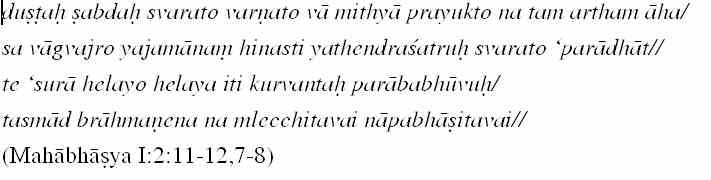
A word defective in accent or phoneme is a sound used incorrectly; it does not convey its purpose. Speech is like a thunderbolt, striking at the sacrificer who mistakes “who is slayer” for “whose slayer.”

The asuras, shouting “Ememies, ememies!” were overpowered. Therefore, a wise man will not speak a language that is not his own or pronounce words incorrectly.

translated from the Sanskrit by Motýlí Voko


Sanskrit poemThe sacrificer is Tvashtr the Creator whose three-headed son Vishvarupa the Multiform had been killed by Indra the Conqueror. As a punishment, Tvashtr excluded Indra from drinking soma, the magic juice, during the sacrificial rituals. Indra, nevertheless, sneaked in and drank most of the soma. The magic juice made him sick and gushed from all of his openings. Tvashtr, livid with rage, took the juice that was left and poured it into the sacrificial fire chanting “May the one whose slayer is Indra grow!” (The correct formula would have been “May the one who is slayer of Indra grow!”)

When the juice reached the fire, a being possessed of the powers of fire and juice sprang into existence. Since he developed while rolling (vrt), he was called Vrtra the Roller, and since he had no feet, he became a snake. Because Tvashtr said “grow!” Vrtra indeed grew, consuming food wherever he extended, pushing the oceans back. Indra bribed fire and soma with cakes to come over to his side. Powerless, Vrtra lay shrunk like a leather bag emptied of its contents. When Indra rushed forth intent on killing him, Vrtra pleaded with him: “Do not kill me, for you are now what I was before. Only cut me into pieces, do not make me disappear.” Indra replied: “Okay, you will become my food.”

The asuras and the devas were offsprings of Prajñāpati, the Lord of Wisdom. When it came to dividing the inheritance, the asuras claimed speech, the devas asked for mind; the asuras received the earth, the devas got the sky. The devas plotted against the asuras, asking Mind (he) to make a move at Speech (she). Despite initial failures, Mind seduced Speech, who came over to the side of the devas. The asuras, cut off from their chief weapon, babbled “Ememies, ememies!” and were crushed by the devas.

adapted from the Brahmanas by Admiral Babočka


About the lines and the stories they refer to: The science of grammar, the principle branch of Indian linguistics, builds on the ancient Vedic distinction between correct linguistic usage, which produces sounds that have the power to bring about reality, and incorrect usage, which reduces language into an impotent tool of daily communication. The Brahmanas are fascinating texts that, through a vast range of interpretative techniques, attempt to make sense out of the magic juice-driven creations of the Vedic seers.

Jan Vihan is a contributing writer for In The Fray.


Green in the face

If an Israeli group wants to march in New York, do you allow Neo-Nazis into their parade? If African Americans are marching in Harlem, do they have to let the Ku Klux Klan into their parade? … People have…

If an Israeli group wants to march in New York, do you allow Neo-Nazis into their parade? If African Americans are marching in Harlem, do they have to let the Ku Klux Klan into their parade? … People have rights. If we let the [Irish Lesbian and Gay Organization] in, is it the Irish Prostitute Association next?

—John Dunleavy, chairman of New York’s St. Patrick’s Day parade, telling The Irish Times why lesbian and gay marchers should be kept off the streets, in the closet, on the other side of the rainbow, etc.

There are rules to follow when making analogies. One is that they be logically consistent. To my knowledge, there are no Israeli Neo-Nazis, or African American KKK members. But there are Irish gays and lesbians — including New York’s newly elected council leader, Christine Quinn, who condemned Dunleavy’s remarks.

Just how petty can the parade’s organizers be? They banned not just the Irish Lesbian and Gay Organization but also the Irish Lobby for Immigration Reform, an advocacy group supporting undocumented Irish immigrants (an estimated 40,000 in the U.S.). Perhaps the organizers forget that many of their ancestors were terribly persecuted immigrants themselves, who escaped famine in their own land to face racism and poverty in America — back at a time when America’s borders were open and there was no such thing as an “illegal alien.”

That said, I have to admit I can’t get too worked up over this parade issue because I find all parades to be boring. I’m sure there’s something I’m missing here. But really, what’s so exciting about standing outside in frigid weather watching grown men in funny costumes walk down the street and wave? It’s so 19th century.

Which basically sums up the mentality of the parade’s organizers.

Victor Tan Chen

Victor Tan Chen is In The Fray's editor in chief and the author of Cut Loose: Jobless and Hopeless in an Unfair Economy. Site: victortanchen.com | Facebook | Twitter: @victortanchen


Joe isn’t always wrong

Let me start by saying that I think Joseph Lieberman is a sanctimonious, backstabbing, spineless opportunist, one of those wretched politicians who make their living attacking their own party.  Digby documents an all-too-typical Joementum move.  Let me also add that I’m perfectly happy with conservative Democrats, even when they have to vote against things I believe in to keep their districts happy.  It’s not the positions Lieberman takes that are infuriating, it’s his parroting of Republican talking points.

But this goes too far, as does this.  Supporting the right of Catholic Hospitals to refuse to offer contraception or abortion is not equivalent to supporting rapists, nor is it even equivalent to supporting those positions themselves.

Basic freedom of conscience in this country allows individuals to act on their own morals, so long as this does not directly harm another and is not discriminatory on inalterable ascriptive characteristics like race.  Refusing a woman contraception may not be moral in my mind, but it certainly falls within the range of legitimate moral decisions for someone else.  The same is true for the pharmacist who does not offer birth control pills.  Let the employer deal with it and keep the state out of the decision.

That said, definitely support Ned Lamont.

Pete DeWan


On being ghetto fabulous

Being fashionably ghetto fab these days is all about relating. Relating to the streets, to the hard knock life, to the college dropout. And fashion takes that relating into the world of retail, where what you wear is more important than who you are, and what you’re wearing declares that you’re down. When being fabulous means being ghetto, the fashion world once again co-opts culture, first from hip-hop, then Asian culture, then Latino culture, to co-opting what it means to be poor.

Fashion takes the creativity and ingenuity that comes from being poor and uses it for its own means. When J. Lo was riding on the six, what do you think she was wearing? Not the fur-soaked line of clothing she’s peddlin’ these days. But today’s underprivileged young girl is now expected to outdo herself — she’s the fashion icon who’s flat broke. She’s expected to show us the way to ghetto fabulousness. And how? By scraping together the scarce funds for a Fetish skirt, a Baby Phat top, or a pair of AKADEMIKS jeans. And for what? To look like what she already is — to look like she’s from the streets.

But dropping a couple of fiddies for a piece of mass-manufactured clothing to look like you know the ghetto life is not only counterintuitive, it’s counter-creative. Growing up poor involves creativity that comes from NOT having, not from buying a carefully crafted image of what “being ghetto” is supposed to look like, courtesy of a coddled celebrity.

But that’s not the message in fashion. Fashion takes what it likes and maligns and terrorizes it into submission until any meaning of culture is gone. Putting Buddha on a t-shirt does not a Zen master make. Taking a spiritual figure revered by millions, whose wisdom has been studied and time-tested for thousands of years, and reducing him to a fashion statement? Or turning the sounds of frustration and inevitability of hip-hop into a quest for mo’ bling, mo’ money, mo’ designer labels that a kid from the street can’t afford?

It’s good to look poor is fashion’s message, just as long as you’re not. Otherwise, how’re you supposed to buy all the brand-name crap they’re selling?

They say people in fashion are creative. Yet just as everything and everyone else, ideas have to come from somewhere. And drawing upon the resourcefulness and inventiveness of kids living in poverty to make a fashion statement isn’t very original. And it sure as hell ain’t ghetto fabulous.

Desiree Aquino


Leading the way to the past

Sensing the conservative zeitgeist that is creeping through America, South Dakota is taking the initiative to lead women’s health back into the deprivation of decades past.  South Dakota began its crusade early: in 1998, the state declared that a pharmacist may refuse to dispense emergency contraception to a woman, even if she carries a prescription for it: “No pharmacist may be required to dispense medication if there is reason to believe that the medication would be used to (1) cause an abortion; or (2) destroy an unborn child.”  Unsurprisingly, South Dakota has already banned all medical treatments related to or drawn from human cloning, in addition to banning human embryonic stem cell research.  

On March 6, 2006, South Dakota governor Mike Rounds signed a document banning almost all abortions in the state, making no exception for pregnancies that are results of incest or rape. The new law will be mired in the court systems and will be unlikely to take effect unless it is upheld by the Supreme Court. Justices John Roberts and Samuel Alito, both conservative Justices and Bush appointees, have the potential to swing the Supreme Court into conservatism and to overturn Roe v. Wade, which legalized abortion in 1973. The law is slated to be put into action on July 1st and carries a five-year prison sentence for any doctor who performs an illegal abortion.

Other states are following suit. Alan Nunnelee, a Mississippi state senator, declared, “Roe is the worst kind of law…I believe we can do better.”  He is moving to ban abortion in the state.  

Mimi Hanaoka


Left without God

There’s a continuous argument in Left Blogistan about whether the Democrats should take up more religious rhetoric.  The idea is that this will make a political appeal to the white voters who have abandoned the party over the years.  Basically, this comes in three flavors.

Some say that it is a matter of saying God more, explaining political positions in terms of “values” and religious beliefs.  Voters will recognize that mainline (read moderate) Christianity is just as valid as conservative evangelicalism.  This was a widespread instant response to John Kerry losing to George W. Bush.

Others say that it should be sufficient for the left to more modestly point out that their political values are more in line with the teachings of Jesus (and other religions).  In other words, lefties are better at caring for the meek and the powerless.  The New Testament as a whole is clearly about this approach rather than a fire and brimstone moralism.

I would like to believe that one of these tactics would work.  We all admire the Catholic social worker, the Reform Jewish ACLU lawyer, and the Presbyterian activist for gay rights.  But they are not the face of activist religion in America today.

So, I have to agree with those who say that there is no point in really getting into this argument.  The people that are voting on religious grounds are not going to be swayed by a few more mentions of God and morals.  They are really supporting a conservative social order with its attendant opposition to gay rights, feminism, and the like.

Conservative Christian polemicist Thomas Reeves has it right here.  As a larger social trend, liberal religion is a first step towards no religion.  That is why these churches keep getting smaller while more moralistic brands are increasing in size and influence.

There’s no reason to attack the religious.  That would be both wrong and stupid.  But to believe that the left can co-opt this religious fervor is plain wrong.  For many years it seemed that modernity would lead to more liberal and less religious societies, and the American left imagined that Western Europe was our future.  Nobody can say whether that will still be true in the long run, but the engagement of religion in politics today is a reaction against liberalism.  It should be recognized for what it is.

Pete DeWan


The Urban Iditarod: A tribute to the last great race on Earth

On Saturday, March 4, 2006, the Bay Area community took part in the twelfth annual Urban Iditarod. The event is a lampoon celebration of the annual Alaskan iditarod, which also began on this day, where huskies and sleds are replaced by canine getups and shopping carts. Approximately twenty-five teams entered in to compete in an expedition across the San Francisco streets.

Nearly 1,000 people assembled in the Minna Street Alley some time after 10 a.m. Teams began rallying their spirits around shopping carts filled with beer, rum, vodka, and radios. Contingents distinguished themselves with creative canine identities. Other squads included the Brown Hornets, Jamaican Bobsled Team, and ESPN 8 Yocho. Shopping carts were led by a musher and powered by four pack animals. Racers utilized this vital preparation time to socialize and liquify their courage because, according to Ben Stein, a member of the Dog the Bounty Hunter Team, “There’s no ice in paradise.”

The event attracted a diverse crowd of international proportions. John Maris, a member of Dr. Hwang’s Korean National Dog Cloning Team, disembarked from Auckland, New Zealand to partake in the race. Other athletes came in from various parts of California from Sacramento to San Diego.

Hype and excitement brewed until high noon, when the Alpha Dog unleashed the teams onto Market Street’s jagged asphalt terrain. Competitors traversed perilous high-traffic intersections packed with confused shoppers and impatient drivers. Sidewalk bystanders cheered as the mob of turbulent challengers hurdled over trolley tracks and insidious potholes.

Through the eyes of the press however, the event was similar to the running of the Bulls in Pamplona.
        
After pausing in a back alley to recoup, the horde barreled through the China Town Gate heading north, howling along Grant Avenue until they reached Washington Square Park.
        
The course extended onto Powel Street in the North Beach area. Racers crossed the finish line at Fishermen’s Wharf, where all were treated to the open courtyard at Jack’s Cannery bar for parlay and praise. Amidst upscale floral arrangements in the quaint cafes along the perimeter, associates of the Iditarod raged until the spirits had been exercised.

Andrew Hodgdon


Dregs of Dead Men

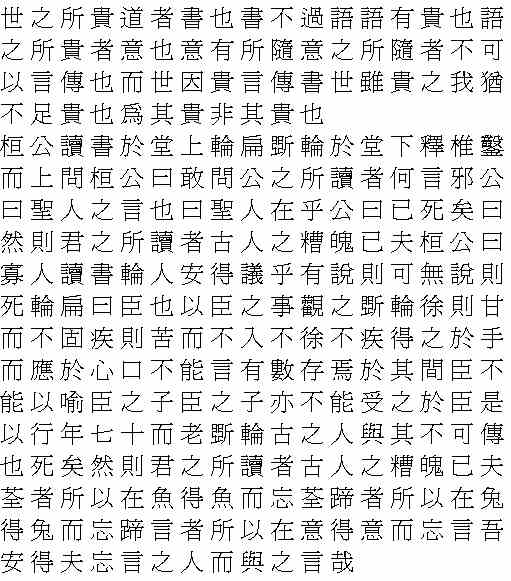
Books are no better than talking. In talking there is something precious: the intention. Intention tunes to something, but what it tunes to cannot be passed down through words. Yet, because they treasure words, people transmit books. Let them treasure it! For me there is nothing worth treasuring there. What they value in words is not what they are precious for.

Duke Huan was reading a book in the hall. Wheelwright P’ien was carving a wheel nearby. Putting down his chisel, the wheelwright went up to the duke: “May I ask what words my lord is reading?”

“The words of a wise man.”

“Is the wise man alive?”

“He is dead.”

“Then my lord is only reading the dregs of a dead man.”

“How do you, a wheelwright, dare to pass judgments when your master is reading? If you can justify yourself, good for you; if not, you die!”

“I look at it from the point of view of my own work. When I pound the chisel too softly, it does not hold on to the wood; when I pound too hard, it does not incise. Not too soft, not too hard—my hands find the way, and the mind follows through, but the mouth cannot explain it. There is a measure in it I cannot relate to my son, and my son cannot learn from me. I have been doing this for seventy years, growing old carving wheels. The men of the past are dead, along with what they could not pass down. Thus all my lord is reading are the dregs of dead men.”

The point of the net is the fish. When you get the fish, you can forget the net.

The point of the snare is the hare. When you get the hare, you can forget the snare.

The point of the words is the intention. When you get the intention, you can forget the words.

Where do I find a man who has forgotten words, so that I can have a word with him?

translated from the Chinese by Motýlí Voko

About the piece: Anecdotes like this one circulated through China’s central states for centuries, attributed to the semifictional character Chuang Chou. Linked by a playful poetic language, they poked fun at conventional wisdom. They were later collated into the definitive book of Master Chuang by the Taoist scholar Kuo Hsiang (who died in the forty-seventh year of the Western Chin, i.e., 312 AD).

Jan Vihan is a contributing writer for In The Fray.


For they know not what they do

The body of Tom Fox, one of the four peace activists kidnapped in Iraq last November, …

The body of Tom Fox, one of the four peace activists kidnapped in Iraq last November, was discovered Thursday. The 54-year-old father of two, a member of the Chicago-based Christian Peacemaker Teams, had been tortured with electric cables before being shot in the head.

Fox, a Quaker, was a dedicated activist who spent the last two years of his life in Iraq, working with Iraqi human rights groups to foster peace and seeking a richer understanding of Islamic culture. As a peacemaker he found his inspiration in Jesus and Gandhi, who taught him to stand firmly, nonviolently, against evil. Writing to his fellow activists in October, Fox asked them to remember the Mahatma’s words: “A person who has known God will be incapable of harboring anger or fear within him, no matter how overpowering the cause for that anger or fear may be.”

The day before his abduction, Fox shared another short reflection titled “Why are we here?” Here is an excerpt:

I have read that the word in the Greek Bible that is translated as “love” is the word “agape.” Again, I have read that this word is best expressed as a profound respect for all human beings simply for the fact that they are all God’s children. I would state that idea in a somewhat different way, as “never thinking or doing anything that would dehumanize one of my fellow human beings.”

As I survey the landscape here in Iraq, dehumanization seems to be the operative means of relating to each other. U.S. forces in their quest to hunt down and kill “terrorists” are, as a result of this dehumanizing word, not only killing “terrorists,” but also killing innocent Iraqis: men, women and children in the various towns and villages.

It seems as if the first step down the road to violence is taken when I dehumanize a person. That violence might stay within my thoughts or find its way into the outer world and become expressed verbally, psychologically, structurally or physically. As soon as I rob a fellow human being of his or her humanity by sticking a dehumanizing label on them, I begin the process that can have, as an end result, torture, injury and death.

“Why are we here?” We are here to root out all aspects of dehumanization that exist within us. We are here to stand with those being dehumanized by oppressors and stand firm against that dehumanization. We are here to stop people, including ourselves, from dehumanizing any of God’s children, no matter how much they dehumanize their own souls.

His hopeful words then sting us now with a painful irony. This is all the more true of the “statement of conviction” that Fox and his fellow sojourners signed last March, in which they acknowledged the dangers of their work in Iraq — and yet insisted its importance outweighed the risks. “We hope that in loving both friends and enemies and by intervening non-violently to aid those who are systematically oppressed, we can contribute in some small way to transforming this volatile situation,” the statement read.

Even if the love they showed to their enemies was not enough, there could be no hatred in their hearts, the statement went on to say. In the event of hostage-taking, “We will try to understand the motives for these actions, and to articulate them, while maintaining a firm stance that such actions are wrong…. [We] reject violence to punish anyone who harms us…. We forgive those who consider us their enemies.”

We will never know for certain what thoughts went through Tom Fox’s head in the moments before his death. But if the words and deeds he offered over the course of his life are any indication, he faced his murderers without fear, or anger.

Acknowledging the humanity that they had forsaken.

Forgiving them, for they knew not what they did.

Victor Tan Chen

Victor Tan Chen is In The Fray's editor in chief and the author of Cut Loose: Jobless and Hopeless in an Unfair Economy. Site: victortanchen.com | Facebook | Twitter: @victortanchen


The Great Oscar Quiz answers revealed

The 78th Academy Awards have come and gone and, as a show, it was okay but nothing to remember past March except that Crash derailed Brokeback Mountain to take the top prize.  Speaking of prizes, give a big round of applause to Kacie Seaman, winner of the Great Oscar Quiz and who only got two wrong answers out of the 15 regular questions.  If we could, we’d allow her to give an acceptance speech behind annoying music and then cut her off before she had time to thank her mother or agent or lawyer or dogsitter.

Anyway, here are the answers for all of those who were afraid, very afraid of trying to participate in the quiz.  Maybe next time you’ll give it a go and know that all the answers are somewhere on the Web.  You just have to dig.

The 2005 Great Oscar Quiz answers

1. What 2005 nominated actor appeared in a 1991 film that also featured an actor nominated in the same category?
ANSWER: In City Slickers, Jake Gyllenhaal played Billy Crystal’s son, and one-arm push-upper Jack Palance won Best Supporting Actor, playing a cowboy named Curly who was far from being gay though he liked redheads.  Carrot Top can be relieved both character and actor have passed on to the great movie range in the sky.

2. Which 1960 winner was Debbie Reynolds referring to when she said, “Hell, I even voted for her”?
ANSWER: Elizabeth Taylor, who won Best Actress for Butterfield 8 and who stole Reynolds’ ex-husband Eddie Fisher away from her.  Taylor would then leave Fisher for Richard Burton.

3. One of this year’s Best Picture nominees was filmed in black and white.  What was the last black and white film to win Best Picture?
ANSWER: Schindler’s List in 1993, winning a total of seven awards. The film did contain a little color — the girl in the red jacket, the ending march by Schindler’s grave —  but generally was considered a black & white film.  You have to go back to 1960 and Billy Wilder’s The Apartment for a film entirely in black & white.  Both answers would have been acceptable.

4. What star of NBC’s The West Wing performed a rendition of Proud Mary with Snow White (Eileen Bowman) on an Oscar telecast that came to epitomize the over-produced musical numbers that since have been curtailed, and what was the date on which the telecast took place?
ANSWER: Rob Lowe, March 29, 1989.

5. What 1975 winner was escorted to the ceremony by twin sons he or she had not seen since 1968?
ANSWER: Milos Forman, Best Director for One Flew Over The Cuckoo’s Nest.

6. What was the original category title for what is now Best Picture, used for the first three ceremonies beginning in 1927?
ANSWER: Production.  It was changed so members wouldn’t vote solely on size or logistics.

7. Walt Disney has the record for most nominations ever at 59, but what living individual (Oscar night categories only) has the most career nominations on his/her resume (45 and counting), including this year’s nominations?
ANSWER: Musical Score composer, John Williams, who failed to add another statuette this year, but I’m sure he’ll be back.

8. What presenter revealed to Joan Rivers on the red carpet before the 1994 awards that “I just got over excited in the car.”
ANSWER: Hugh Grant, escorted by his then girlfriend Elizabeth Hurley.

9. What 1946 Best Picture loser but now classic film was praised by a New York Daily News editorial saying, “It momentarily restored this reporter’s faith in human nature — quite some achievement after you’ve spent sometime in the newspaper game.”?
ANSWER: Frank Capra’s It’s A Wonderful Life, starring James Stewart and Donna Reed.

10. What was the only television film to be adapted to the big screen and win Best Picture?
ANSWER: Marty, 1955.

11. Who is the only Oscar to win an Oscar?
ANSWER: Oscar Hammerstein II for Best Song, 1941 and 1945.

12. What film holds the record for the most nominations without a single loss?
ANSWER: Lord of the Rings: The Return of the King, 2003 at 11.

13. Who was the first Best Actor nominee to be nominated for portraying another Best Actor nominee?
ANSWER: Robert Downey Jr., nominated for Chaplin, playing Charlie Chaplin.

14. Who are the only twins to win Oscars together and for what film?
ANSWER: Julius and Philip Epstein, winning Best Screenplay for Casablanca.

15. Which 2005 double-nominated individual began his/her career on the TV sitcom One Day at a Time?
ANSWER: Paul Haggis, nominated for Director and Screenwriter for Crash.  He won for Best Original Screenplay and shared the Best Picture Oscar as a producer for Crash as well.

Tie-Breaker Questions

What Oscar-winning actor, presenting at the 1994 awards ceremony, was brought to the stage by the announcer saying he is, “Unique. Original.  His nationality is Actor.”?
ANSWER: Jack Nicholson.

Who will win Best Live Action Short Film?
a) Ausreisser (The Runaway)  
b) Cashback  
c) The Last Farm  
d) Our Time Is Up  
e) Six Shooter
ANSWER: Six Shooter

Rich Burlingham