Blog


Last stand for choice in Mississippi

Listen to the programIn Jackson, Mississippi, a red state in the heart of the Bible Belt, the battle over abortion was kicked into high gear when an eight-day anti-abortion demonstration ensued in the state's capital this past summer.

On one side: activists fighting to save the last abortion clinic in the state. On the other: Operation Save America trying to shut it down.
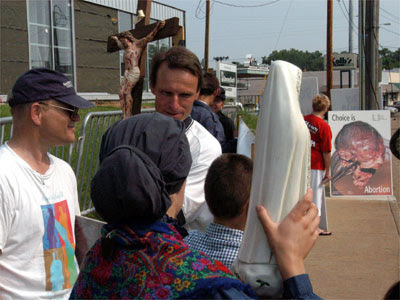
*Operation Save America members protest in front of an abortion clinic in Jackson, Mississippi during their 2006 National Event in that city. The group frequently uses images of aborted fetuses to attract attention to their cause

On this edition, "Making Contact's" Sarah Olson takes a closer look at the Mississippi women fighting for reproductive justice as they try to save the one remaining abortion clinic in the state.

Featuring: Pastor Flip Benham, director, Operation Save America; Adam Tenant, Operation Save America; McCoy Faulkner, women's organizations and abortion clinics security officer and retired cop; Betty Thompson, counselor and administrator, Jackson Women's Health Organization; Michelle Colón, president, National Organization for Women-Jackson Area; Shannon Reace, Mississippi Reproductive Freedom Coalition HIV/AIDS advocate; Norma McCorvey, lead plaintiff in Roe v. Wade but now anti-abortion activist; Kim Ghandy, president, National Organization for Women (NOW); Jenni Smith, Unity Mississippi; Shauna Davie, Jackson State University student. Senior Producer/Host: Tena Rubio. Freelance Producer: Sarah Olson. Mixing Engineer: Phillip Babich. Freelance Associate Producer: Emily Polk. Intern: Alexis McCrimmon.

For more information: Jackson Women's Health Organization, 2903 North State Street Jackson, MS 39216; 601-366-2261; www.gynpages.com/jwho

National Women's Health Organization, 3613 Haworth Drive, Raleigh, NC 27609; 800-532-5383; www.nationalwomenshealth.org

National Organization for Women (NOW), 1100 H Street NW, 3rd floor, Washington, D.C. 20005; 202-628-8669 (628-8NOW); www.now.org

Feminist Majority Foundation, 1600 Wilson Boulevard, Suite 801, Arlington, VA 22209; 703-522-2214; www.feminist.org

National Abortion Federation, 1755 Massachusetts Avenue, NW, Suite 600, Washington, D.C. 20036; 202-667-5881; naf@prochoice.org, www.prochoice.org

Guttmacher Institute, 120 Wall Street, 21st Floor, New York, NY 10005; 800-355-0244; www.guttmacher.org

ACLU Reproductive Freedom Project, www.aclu.org/reproductiverights/index.html

Mississippi Reproductive Freedom Project-ACLU of Jackson, Mississippi; 601-355-6464; missrfp@yahoo.com; www.msaclu.org/mrfp/index.html

Unity Mississippi, P.O. Box 4212, Jackson, MS 39296; www.unityms.org/index.html

*Photo: Courtesy "Operation Save America." Wikipedia. Wikipedia, 2007. Answers.com 28 Feb. 2007. http://www.answers.com/topic/operation-save-america


Good canals can make good neighbors

greener-geographic2.jpgLast year Panamanians voted overwhelming approval of the planned expansion to the Panama Canal. Since its opening in 1920, the canal has been and remains, today, a vital link to East-West shipping between the Americas, Europe, and Asia. cosco.jpg

Photo:The Nordcapital Group

Recent advances in ship design, however, have put pressure on the canal to refit its infrastructure to allow passage of supertankers, sometimes called “over-panamax,” or too large to transit the canal. The current width allowance of Panama’s locks system is about 32 meters wide, or 104 feet.

The largest supertankers in service today are on the order of 63 meters wide, almost double the width allowable through the locks at Panama.

The expansion, which is scheduled to be completed in 2014, will increase the canal locks’ capacity to 55 meters wide, about 180 feet. With that, the Panama Canal system will once again be open to all but the very largest carriers. Gulf ports like Tampa, Galveston, and Baton Rouge are already making plans to accommodate increased shipping schedules.

Perhaps the most significant outcome, however, is that by this timely upgrade to the Panama Canal, East Coast and European Union countries can once again transit the safer, faster route to Asia through the Panama Canal; the infrastructure that so influenced East-West trade from the mid-20th century will once again enable Panama to play a lead role in an increasingly competitive global market.

Related::

With the announcement by Dubai Ports World in December that it would sell to rival AIG its U.S. ports management operations, including seaports in New York/New Jersey, Philadelphia, Baltimore, Miami, Tampa, and New Orleans, the giant United Arab Emirates corporation signaled its exit from the North American market and pressure mounted once again for East Coast ports to refurbish and upgrade their infrastructure.

The move away from U.S. ports management by DP World had been widely anticipated following the storm of criticism surrounding the revelation that the UAE-owned company was managing port operations in several U.S. locations. Many “run-for-cover” politicians deemed the situation threatening to homeland security. Among them, New York’s then-mayor Rudy Giuliani and Senators Charles Schumer, D-NY, and Robert Menendez, D-NJ, claimed that the United Arab Emirates-based company constituted a grave security risk.

Now Menendez and Schumer, two of DP World's loudest critics last year, find themselves defending the company’s new deal and bemoaning the port agency’s “greed,” saying that the New York and New Jersey Port Authority’s demand for 84 million dollars in payments from the new owners for past improvements and future upgrades to infrastructure is unconscionable and will spoil the deal.

If the deal falls through, DP World might yet find itself in a position to capitalize on its market share of operations in western ports, a prospect that, perhaps, may not disappoint DPW’s investors, provided of course that the politicians can refrain from muddying the waters.


When personal and political mesh

When I agreed to begin writing for InTheFray, I promised that my personal biases, thoughts, and experiences would not dominate the things I wrote here. As an avid blog reader, as well as a journalism student, I believe that blogs beginning with the words “from my experience” are often uninteresting to the readership and convey little more than a narrative. However, today’s topic was literally handed to me from my own experience, and that is what I have to go with. I hesitated on posting this for more than a week, just to make sure I was giving the incident its social and political justice, and that I wasn’t just using this as a place to rant. But I think it makes sense when you look at it from the outside.


I live in a small-city-turned-college-town by its home to, historically, one of the strongest athletic programs in the Big 12. I live on the edge of campus, right near downtown, and am able to watch the city and the university mix together in a unique fashion. Although I write crime for the university’s student newspaper, I have never feared walking alone at night from my job or doing most activities independently.

But today everything changed. I had my car battery replaced and decided to stop at a gas station down the road from my dormitory. I had walked there before over the fall; it wasn’t that far away. They had good prices. It seemed a perfect fit.

But I didn’t fit in. As I walked into the store, a man with dreadlocks in a newer blue car stopped me, asking repeatedly what my name was and then for me to get into his car. I stared at him blankly, refusing any other response except to walk into the store to buy glass cleaner. I just wanted to get my windows clean.

I exited the store, Armorall and Mountain Dew in hand, and started the lengthy task of washing the windows on my Jeep.

I didn’t realize how out of my element I apparently was until two young men, close to my age, started shouting at me. Then, I started getting scared. But I tried to just keep washing my windows and the seat covers in my car. I didn’t want to seem scared. After all, I paid taxes here, too – it’s my city, too.

After the men retreated behind the side of the building, my heart stopped racing a little bit, and I began to put everything back into my car so that I could leave and head back to the dorm before going to classes. But I didn’t get much time to relax, or slow the adrenaline that was pulsing through my veins like fire.

All I could think at that moment was how much I wanted to go home. No, not to the dorm on the campus I’ve lived since August, but home, to my home. Where I drive everywhere safe and secure in my two-door Jeep. Home, where my mother is a vigilante and watches out the back door when I drive in from work late at night. Home, where I’ve never felt insecure and never questioned my own safety while trying to fill a car with gas.

But I just calmly drove back to my dorm, taking the long route as to avoid being followed, and dialed my mother on my cell phone as I did so. It took all of my willpower not to burst into angry tears.

“You go to college in a small town with a small-town mentality,” she said. “You guys need to keep traveling in packs.”

I knew she was right, but I didn’t want to be confined to leaving the dorm or the vicinity of my classes to only when two or three of my friends could tag along. These were my streets – the streets where I had wandered excitedly after making my college choice less than a year ago. These are the streets I was supposed to feel comfortable and at home on. Now, all I want is to get away from them.

What right do men walking at the corner of Providence and Walnut have to rob me of my security, of the knowledge that any streets I choose are my own? They don’t have the license to take away my safety – but I’ve given it to them by my own fear.

Tonight, I am driving around a campus I usually walk with abandon because I do not want to be caught off guard. I will drive to another part of the city to fill my car with gas. It is likely my boyfriend will fill a role he was never meant to – a watch guard of sorts, because I am too wary to wander on my own at night.

Follow-up postings discussing the issues of women’s safety and offensive attitudes in small towns will follow shortly. Sometimes the personal and the political merge in a unique matter. Sometimes, we can’t help but speak from what we know, rather than what we have to say.


Babel babble

Babel is the name used in the Tanakh (Genesis chapter 11) to describe the historical city of Babylon, commonly thought to be the location of the Tower of Babel. The word "babel" is thought to come from the Hebrew verb "balal," which means to confuse or confound.

The film Babel, directed by Alejandro González Iñárritu, does just that. Unfortunately, I saw it in the Netherlands on vacation this past December; unfortunately because it was subtitled in Dutch and therefore the portions in Japanese went directly over my head (my mediocre Spanish got me through the Mexican segments, and having lived in Morocco for the past two years, I was able to understand the majority of the Darija, or Moroccan Arabic, and what I didn't get, my husband, who was sitting next to me, explained).

But despite the fact that a language barrier kept me from fully comprehending the film, the film itself seems to confuse. One particular aspect of it, that which took place in Morocco, confounded me.

First of all, and I don't mean to pick, but as a friend who has lived in the region informed me, the village in which the Moroccan scenes took place Tazarine was not actually the village used for filming instead, a village called Taguenzalt was used. Director Iñárritu said of the village:

"I liked that this village was very humble and very real. The people in Taguenzalt were extremely nice and spiritual…I felt very safe there."

In the film's production information, it was also noted that the villagers can trace their Berber ancestry back 3,000 years. Interesting! Why then, were they speaking Darija, the Moroccan dialect of Arabic, and not Tamazight, the local Berber dialect?

Other friends have also noted the fact that much of the dialogue sounds like English (or Spanish) translated directly into Darija meaning, of course, that much of the Moroccan characters' speech is inauthentic.

I was pleased to see that the shooting in the film was an accident prior to seeing it, I had assumed, knowing that Cate Blanchett's character gets shot, that the portion in Morocco would deal with terrorism but aside from that, found myself disappointed.

And so I am pleased, of course, that The Departed was this year's Best Picture winner at the Academy Awards…despite the fact that I haven't seen it.


“Academy” has a weightier voice

You can keep the politics out of the Academy Awards.

Well…not really. Tonight’s winner for Best Live Action Short Film, West Bank Story, makes sure that the Oscars see a dose of what’s really on intellectual America’s mind.

Beyond the questions of what exactly Nicole Kidman is wearing and who will win the coveted Best Picture award, the reality is that America still exists outside of the Kodak Theatre in Hollywood, even tonight.


Two fated lovers meet West Side Story-style between two opposing falafel stands in Ari Sandel’s comic take on the conflict between Pakistan and Israel. The dance clips, found both in the trailer and the film, could compete with any Broadway musical.

Short or not so short, this film can roll with the punches. And Sandel encapsulated the tension between the film’s weighty subject matter and lighthearted approach perfectly for the billions of viewers.

“One of the things I wanted to do was combat all of the negative news that’s constantly in the news about the situation, and I felt that the best way to do that would be through comedy,” said Sandel.

And his approach on the always-pressing situation in the Middle East was not the only political commentary, to be sure.

As Leonardo DiCaprio and former Vice President Al Gore announced, the Academy Awards have “gone green.”

“Though we may have a long way to go, all of us can do something in our own lives to make a difference,” said Gore, after gracefully refusing DiCaprio’s bait to announce his often-debated position on running for Commander in Chief of the United States.

We still don’t know what Gore’s up to as for 2008, but we do know one thing for certain after tonight’s awards the American public and the global public is not as vapid as commonly teemed.

While fashion, fun, and entertainment matter, so do national politics, international politics, and thinking green, even in the entertainment industry.


Anatomy of a homophobe

Here's a fascinating interview with Tim Hardaway, the retired basketball player who said in a radio interview earlier this month that he "hated" gay people.

Here's a fascinating interview with Tim Hardaway, the retired basketball player who said in a radio interview earlier this month that he "hated" gay people. He says he's trying to atone for the hurtful remarks he made:

I want to get my s— together…. Right now, learning. Learning that gay people are really no different than a lot of other people. Learning that they work hard, they do things in the community, they are responsible for building parks, rec centers, providing safe environments for kids, just things I had never associated with them before. [This last week] has opened up my eyes to the gay population and what they do. I'm getting a lot of knowledge about them that I didn't have. Which is going to make me a better person. And if it doesn't, then I'm a damn fool.

At the same time, Hardaway says he still doesn't "condone what they [gay people] do." He points out that he grew up in a Chicago neighborhood where people avoided gay culture like the plague. He insists that gay basketball players who keep their sexual orientation a secret are betraying their teammates.

To be fair, lots of people share Hardaway's fears and prejudices. And why not? Many have grown up without any exposure to what it means to be gay except for the jokes of insecure teens and media images that constantly portray gay people as sexual predators. Once they actually spend time with people of another sexual orientation, they realize that, no, not all gay people want to hit on them. Living with a gay roommate is not an assault on their manhood. Whatever society has put into their heads about homosexuality being disgusting or immoral or against God's plan, they have the ability to think for themselves.

In recent months a good number of celebrities have gotten into trouble for bigoted remarks. It's fun to point and laugh, but people like Mel Gibson and Michael Richards and Tim Hardaway reflect the views of many other people in our society. So perhaps all the media attention will be a positive thing, in the end. Maybe it'll force us to reexamine our own prejudices.

By the same token, perhaps all the coverage of Britney Spears will inspire us to reconsider our prejudices against bald people who don't wear underwear. I'm not sure what the coverage of Anna Nicole Smith has to tell us, but I'll let you know if I do.

Victor Tan Chen is In The Fray's editor in chief and the author of Cut Loose: Jobless and Hopeless in an Unfair Economy. Site: victortanchen.com | Facebook | Twitter: @victortanchen


Senegalese election a potential watershed for democracy in West Africa

Tomorrow's democratic elections in Senegal may mark the last hoorah for octogenarian, reform President Abdoulaye Wade. Wade, who was elected to the presidency in 2000 by a coalition of all the Senegalese people, including Christians, Animists, and Muslims, leads the socialist opposition party known as the Senegalese Democratic Party (PDS).

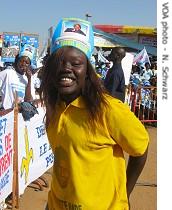
voa_nschwarz_senega_wade_supporter_23feb07.jpgThe president's final campaign rally was held Friday in Dakar, the Senegalese capitol. Cheered by hundreds of youthful supporters, Wade told the crowd that he would bring jobs to the country’s youth, those who are desperate for a chance to leave the country. Many young men and women attempt to illegally emigrate to Europe in hopes of finding employment. 
His election marked the first time since Senegal achieved independence in 1960 after 300 years of French rule that there was a peaceful transition of government when socialist President Abdou Diouf, who had ruled since 1981, stepped aside.

The country of approximately 12 million is the only West African nation to have successfully avoided political violence in the form of a coup, which most observers credit to the Senegalese democratic experience under French rule.

Wade is anticipated to emerge victorious in Sunday’s election, having the support of a majority of the country’s Muslim base led by the Mourides. The Mourides are a Sufi Muslim brotherhood founded in Senegal in the early 1900s.  Millions of Senegalese claim allegiance to them.

Several days ago, supporters of Mr. Wade were accused of disrupting a rally for a former protégé of the president, Idrissa Seck, who is now a rival for the presidency.
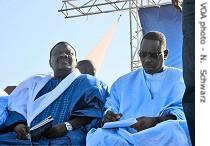
Seck's campaign team blamed the attack on followers of voa_nschwarz_senegal_thioune_sall_23feb07.jpgCheikh Bethio Thioune, a Mouride leader who, at Friday's rally, sat on center stage with Mr. Wade. Thioune denied any involvement in the violence at the Seck rally, while at the same time acknowledging that he favors Wade’s candidacy.
Senegalese election rules prohibit any candidate from attaining office without at least a better than 50 percent minimum of the popular vote. There are 15 candidates in Sunday’s election, so Wade, some believe, may not make it in the first round. If that happens, there will be a runoff election between the two leading candidates on March 11.

In recent years, thousands of young Senegalese have arrived by boat, hungry and ill from the hazardous trip, suffering from exposure, and angry at the lack of opportunity they say faces them in their homeland. No one knows for certain how many have died on these voyages. Their much painful slogan is "BARCELONA OR DEATH."

At the rally, the president promised to embark the nation on an unprecedented round of modernization, which would create jobs in construction as the country improves its infrastructure by building modern hotels, airports, highways, and a new rail system.

Additional Resource:: CIA World book, Senegal


Marriage and brains

Finally, an article saying that you girls can get yourself hitched, and be happy, even if you gots yourself some book learnin'. Of course, we could also ignore these types of articles, no matter which side they take, and live our lives the way we want anyway. I'm going to take that path. I'll let you know how it works out in about 50 years.


Oscars and Obama

I don't focus on entertainment, but I would just like to say: if Jennifer Hudson does not win tomorrow night, I will never go to the movies again. That's all.
Now, Mr. Obama – thank you for finally having the balls to say such things. At this point, you have my vote.


First Bronx River beaver sighted in 200 years

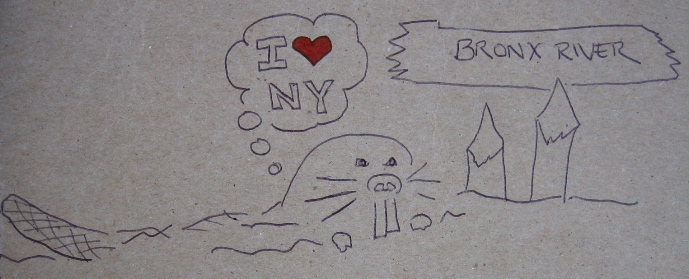
The most exciting news about New York City environmental conservation is the report of a wild beaver seen building a nest in the former toxic waste dump of the Bronx River. His mud and stick house was spotted in the river earlier, but it wasn’t until Wednesday, February 21, 2007 that biologists caught the beaver on videotape, thereby confirming his existence. Beaver, once abundant around the Bronx River, were heavily hunted for their fur and have not been seen in the area since the early 1800s.

Since last fall, scientists began monitoring the river after several reports of beaver sightings from residents. Previously dismissed as the more common muskrat, the biologists changed their tune when they discovered a 12-foot-long dirt and twig habitat near gnawed-off trees by the riverbank this definitely pointed to a beaver. And the actual beaver sighting on Wednesday showed him swimming around looking for more building materials for his growing lodge. The scientists believe the beaver is a young male about two to three years old who is looking for a female partner.

The beaver is named José in tribute to U.S. Representative of the Bronx José Serrano, whose commitment to Bronx River cleanup was cemented with $15 million in government funds.

Beavers are especially meaningful to New York State because they are the official state animal. They appear on the City of New York’s official flag twice as well as on the official state seal.

Bronx River woes
The history of the beaver trapping along the Bronx River began in the early 1600s when Europeans came to the area, then known by the Mohegan Indian name Auqehung. The river soon became an industrial mill zone, the water powering several plants such as paper and flour mills. Jonas Bronck was the mastermind behind the mills; after buying some 500 acres of land from the Native Americans, soon the river was known as “Bronck’s River.” By the early 1800s, when the last beaver was sighted, the river area was still an ecological wonder with thick forests and pristine drinking water. However, by the mid-1800s, the river changed into an industrial waste zone and its degradation would continue until the 1970s. The Bronx River Restoration Project began in 1974 to begin the cleanup that 33 years later led to native species like the beaver returning. Organizations like the Bronx River Alliance lead the way for environmental protection of the river.

Beavers are vital for the environment
Beavers create sustainable habitats that are essential for surrounding flora and fauna alike. They naturally prune and rid areas of foliage and, in doing so, create a thriving environment for the leftover vegetation. The dams they build create a natural filter, slow erosion, and build wetlands for birds and reptiles. Beavers also naturally regulate their population by breeding only once a year and instinctively know when to have more or less babies, called kits. For more about these critters, click here.

Environmental cleanup does have substantial success as evidenced in this case of the first beaver to be spotted in the Bronx River in 200 years. The rewards and environmental benefits that native species bring to an ecological area are so positive that, by changing our polluting habits, we are also greatly improving our own lives.

keeping the earth ever green


Jailed for blogging in Egypt

Despite the fact that Egypt is scheduled to host a forum in 2009 on the topic of Internet governance, Egypt today put a blogger behind bars for four years after he was convicted of insulting Hosni Mubarak, Egypt’s seemingly eternal president, and insulting Islam.

Abdel Karim Suleiman, 22, a former law student at Egypt’s al-Azhar University, a traditional seat of learning, was sentenced during his five-minute court session to one year for insulting President Mubarak and three years for insulting Islam.

Amnesty International decried the sentence as “yet another slap in the face of freedom of expression in Egypt.”