
“Fact-finding mission.” The phrase kept popping to mind in the weeks before my wife Mardena and I left for the Middle East. When it did, I cringed inside. I’d never have said something like that out loud. In reality, all we’d be doing was traveling, as usual. It was obvious, though, why I was hung up on the phrase: it nailed why I wanted to go.
 Earlier in that year, 2015, I’d made plans to visit Israel, the Palestinian West Bank, and Jordan. Mostly, it was the West Bank I wanted to see. I’d read a good deal about the Israeli-Palestinian conflict over the years, books by both Israeli and Palestinian writers. It was clear that life in the West Bank was hard—not as hard as in Gaza, but not good. Writers differed, though, on how hard it was. I wanted to see for myself.
I wasn’t looking for facts, exactly, not in the sense of anything I could document. I couldn’t speak Arabic or Hebrew, and I wouldn’t have an interpreter or guide. I was thinking of more informal research, a mix of observations and inferences—lots of inferences. Veteran journalists were reporting on the ongoing conflict in Israel and the West Bank, as they had for decades. I had only my observations—from an outsider’s untutored perspective—to help resolve my questions about the conflict.
We’d planned to travel to the region a year earlier, in 2014, but when war broke out between Israel and Hamas in July of that year, I cancelled everything. After the fighting ended, I read that Hamas would be preparing for another war before long. I decided that if we were going, we’d better go soon.
We landed in Tel Aviv on a hot, sunny afternoon in May. After checking into our room in the city’s Yemeni quarter, we walked to the beach. People were sprawled all over the sand. Israel’s population is roughly 20 percent Arab, but I noticed only three people identifiably Arab, a woman in a black hijab and her two kids. They were sitting off by themselves. The scene was a precursor of sorts: I never noticed Arabs and Israelis mixing in Israel.
As we started back to our room, we passed six shirtless young African men on a beachside walkway. Dark and wiry, they stood around an old-fashioned boombox watching passersby while the machine pounded out obnoxiously loud music. It felt like a bid for attention: look at us, take notice of us, we’re here. If it was, it wasn’t working; passersby ignored them completely.
The men had formed themselves into a sort of circle, as if to protect themselves from the flow of pedestrians. At first I thought they were African Jews, but I realized later they were more likely immigrants. I knew that life in Israel could be tough for this group. Asylum requests could be painfully slow to resolve and were rarely successful, and many Israelis wanted to be rid of the migrants. I wondered if the men felt stuck, dangling in limbo.
Later, I found myself linking the Africans to something we saw driving back to Jerusalem from the Dead Sea. We were passing that morning through Area C, a part of the West Bank with a large population of Bedouins, Arabic sheepherders. A short way off the road I spotted several ramshackle hovels slapped together from wood, corrugated tin, and scraps. The 1995 Oslo II Accords had placed Area C under Israel’s jurisdiction, and it seemed the government couldn’t be bothered to provide adequate shelters for the residents it was responsible for, possibly because the Bedouins were not Jewish and the shelters were not in Israel proper. Not every country, I learned, had taken that hands-off approach: near the southern Jordanian town of Aqaba, we passed a neat row of little cement houses—worlds sturdier and more inviting than what I’d seen in Israel—that the Jordanian government had built for its Bedouin community.
It was disappointing. My grandfather on my father’s side had been a Lithuanian Jew, and my father had been a strong supporter of Israel. Even though my own sense of Jewish identity was minimal at best, I was expecting more of Israel: I thought it could have done better by the Africans and Bedouins.
Walking along Jerusalem’s Old City Wall, we saw ahead of us five armed soldiers in military fatigues, four young men and a young woman, standing on a salient that allowed them to look down into Arabic East Jerusalem and monitor any activity. As the men continued to concentrate on the scene below, the woman turned toward us slightly. Holding her rifle across her chest, she watched us intently, expressionless, as we passed by.
The military presence was not surprising. In addition to the war with Hamas a year earlier, there had been terror attacks and killings by individual assailants in Tel Aviv and Jerusalem not long before we arrived. A British businessman we met at the airport told us that rockets had been intercepted over Ashdod, a nearby coastal town, when he’d been there a few days earlier. Then, as now, violence never seemed far away.
What stood out to me most about the IDF presence, however, was how off-duty soldiers were everywhere. A girl in fatigues, white socks, and sandals, hurrying into a pharmacy in downtown Jerusalem. Soldiers in the central Tel Aviv bus station, praying in a little room set aside for the purpose. A young man who clambered onto our bus on a Monday morning carrying his IDF-issued backpack and rifle. These soldiers just living civilian lives suggested a nation that could mobilize at a moment’s notice. They also conveyed a bit of humanity otherwise lost in the blank stares and coiled stances of IDF personnel. As the soldier sat down on our bus, he placed his backpack and rifle carefully, as if they were alien objects, on the seat next to him. He seemed a little put upon, his mouth turned down slightly in distaste: the weekend over, he was reporting for work on Monday morning, and he looked not at all happy about it.
One afternoon, my wife and I were walking along the beach from Jaffa to Tel Aviv, a stretch of about a mile. A band of a dozen Israeli men came tromping toward us along the shore in a sort of loose military formation, their faces grim. Although they wore civilian clothes, they carried rifles, barrels pointing up, in front of them. They passed without acknowledging us, their eyes trained ahead and their jaws set, resolute to the point of belligerence. It was the strangest sight we saw in Israel. We guessed they were a civilian militia, but we never found out for sure.
A week into our trip, Mardena and I took a bus to Bethlehem, a West Bank city about six miles from Jerusalem. When we reached our Bethlehem bus stop that May afternoon, a group of about fifteen taxi drivers waited on the sidewalk. As our bus pulled up, there was a noticeable jostling among the men, as if a current of energy was passing through them. After some commotion, the dispatcher picked a cabbie, and Mardena and I piled into his dusty compact car.
That was my first inkling that work was hard to come by in the West Bank. We’d see it later when a man on a Bethlehem street badgered us to let him guide us through Jesus’s birthplace, a local historic site. We’d experience it again when a tea merchant wrangled us into following him to his store.
We told our driver the name of our hotel, and we started off. As we drove, I noticed two buildings off to our right, four or five stories each, the structures completed but lacking glass in the window frames. There was no construction equipment around, and the site looked like it had been idle for a long time. It reminded me of Turkey, where it was common to see partially built houses that the owners planned to finish when they had the money to do it.
A little farther on, we passed a group of a half-dozen boys walking along a sidewalk. A stubby middle-aged man in a black-and-white checked keffiyeh followed closely behind them. The man herded the boys along as the group chanted slogans. I realized later they were likely marching in remembrance of the Nakba (“The Catastrophe”), when Palestinians fled their homes during the 1948 war with Israel; the event was being commemorated at the time.
From what we could tell during our time in Bethlehem and elsewhere, life in the West Bank had to be difficult. Since then, conditions there have only deteriorated. Hamas’s October 7 attacks on Israel prompted a massive military assault on Gaza, but a less noticed consequence has been the recent rise in settler violence against the West Bank’s Palestinian population, with attacks surging just this year. Meanwhile, the Israeli government continues to greenlight the establishment of new Jewish settlements in the occupied territory, fueling the conflict.
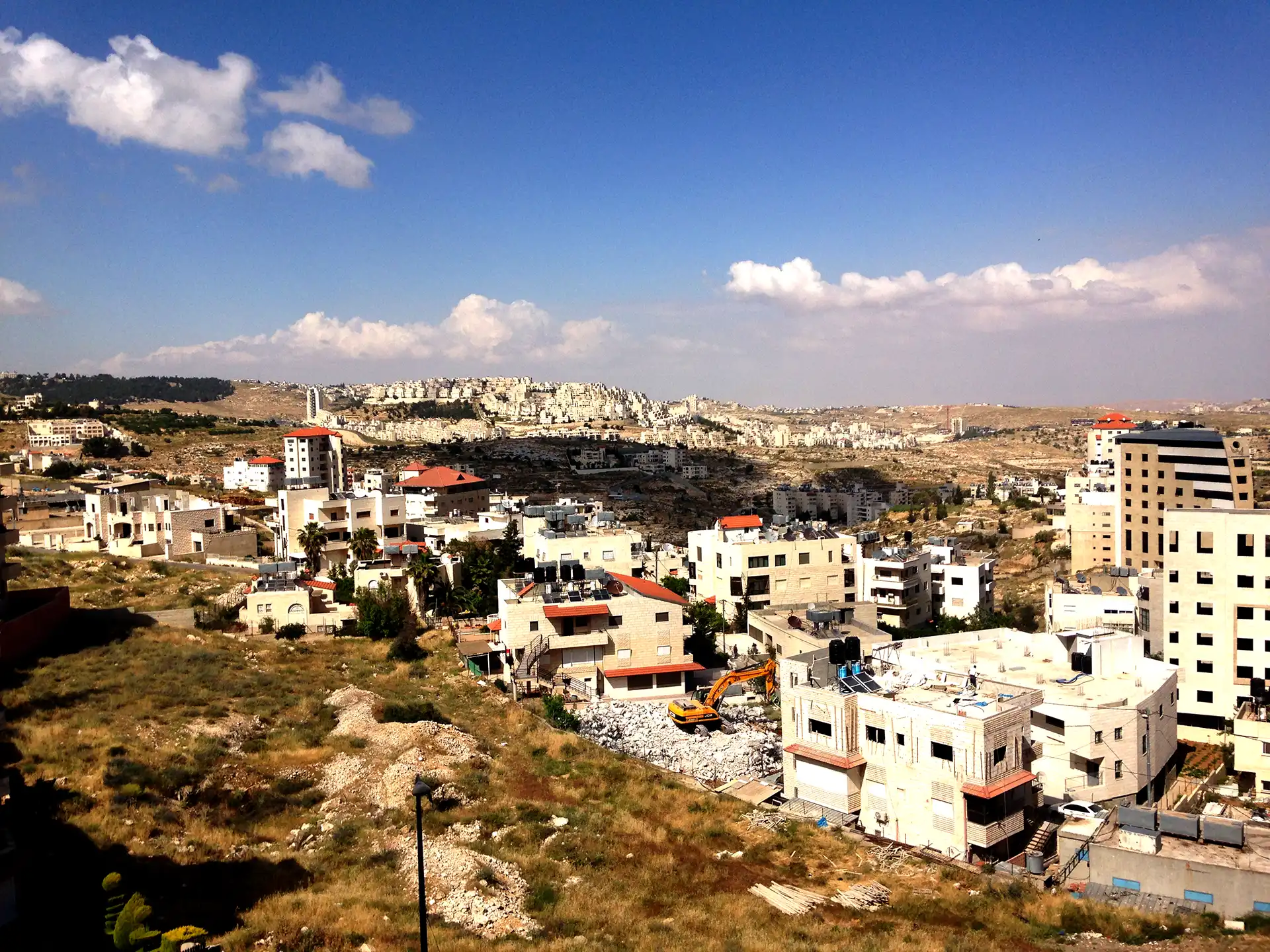
From the window of our Bethlehem hotel room, I could see a collection of newish white buildings sprawling down a hill in the distance. That evening, I asked the young clerk at the hotel reception desk if the buildings were an Israeli settlement. He looked out the window and muttered something I couldn’t hear. But his tone and demeanor, a combination of frustration and resentment, spoke clearly. It was as if he were shaking his head mentally and saying, “Another incursion. What can you do?”
I wondered how I’d have felt looking out there, powerless to resist as Israeli settlements spread inexorably across land that had belonged to my people.
We did see instances of Palestinians pushing back. One afternoon, Mardena and I visited the Temple Mount, a site in Jerusalem sacred to both Muslims and Jews. We were sitting on rock bench in a remote corner of the site when a skinny, bearded Israeli man in a black hat hurried past us, visibly flustered. He was heading toward a side exit a short distance away. Three hefty women in black hijabs followed a few yards behind, waving their arms and yelling. A scene that could have seemed cartoonish was instead unnerving. It seemed that the man had provoked the women, who were intent on running him off the Temple grounds.
The incident called to mind the rage Israeli leader Ariel Sharon ignited among Muslims back in 2000 when he entered the Al Aqsa Mosque compound, an Islamic holy site on the Temple Mount. That single encroachment would have historic consequences, kicking off the second intifada, a series of mass protests across Israel and the occupied territories. The conflict soon descended into tit-for-tat violence, sidelining Israeli voices for a negotiated peace and prompting the IDF to employ increasingly harsh tactics to deal with Palestinian unrest.
One morning, Mardena and I took a bus from Arab East Jerusalem to Ramallah, considered the de facto capital of the West Bank. Near midday, we stopped for lunch at a cafe on the city’s main square. Just down the street was a life-sized statue of a Palestinian gunman dressed in drab olive military garb and a keffiyeh. An ammo belt slanted down across his chest, and grenades encircled his waist. It was an image of violent defiance. The Oslo II Accords gave Palestinians jurisdiction over cities like Ramallah, but I was still surprised Israel hadn’t pushed to have the figure removed.
Israelis could be defiant, too. I spotted Israeli flags fluttering over three apartments in the Arab quarter of Jerusalem’s Old City. The Israelis in those apartments were obviously asserting their right to live in an Arab neighborhood, but I wondered why they felt the need to flaunt their presence. It was bound to create resentment.
Our guidebook said that the Arabic-run guesthouse where we’d be staying in Nazareth had a lobby where people could sit around and chat. This piqued my interest. I hoped we’d be able to talk with other travelers about the Palestinian-Israeli conflict. As it turned out, there was no one to chat with—we were the only guests. That said, I never sensed an opening for bringing up the political situation across any of my conversations in Israel and Palestine. I wondered if people on both sides avoided the topic, especially with outsiders.
One afternoon, we took a taxi out to a refugee camp near Bethlehem I‘d read about. According to our guidebook, the camp had a bustling cafeteria, a feminist group that staged theatrical performances, and a thriving crafts center.
Our excursion didn’t turn out well. The two young women at the camp’s entry desk were mystified about why we were there. I asked if we could see the cafeteria. The women accompanied us there and unlocked the cafeteria door. The room was empty except for a single vending machine. Mardena and I poked around for a minute, and then I went to a window and looked out. Except for two United Nations trucks parked in the square below, there wasn’t a sign of life anywhere. The living quarters across the square, like the ones in camps we’d seen from a distance, reminded me of eyeless skulls, the windows black and lifeless.
Before we left, the women urged us to buy something from the cafeteria’s vending machine, so I bought two candy bars. On the way out we came across two little girls, one about eleven, the other maybe seven, playing on scooters. I offered them our candy bars. The older girl snatched both and scootered off, the younger one howling in protest behind.
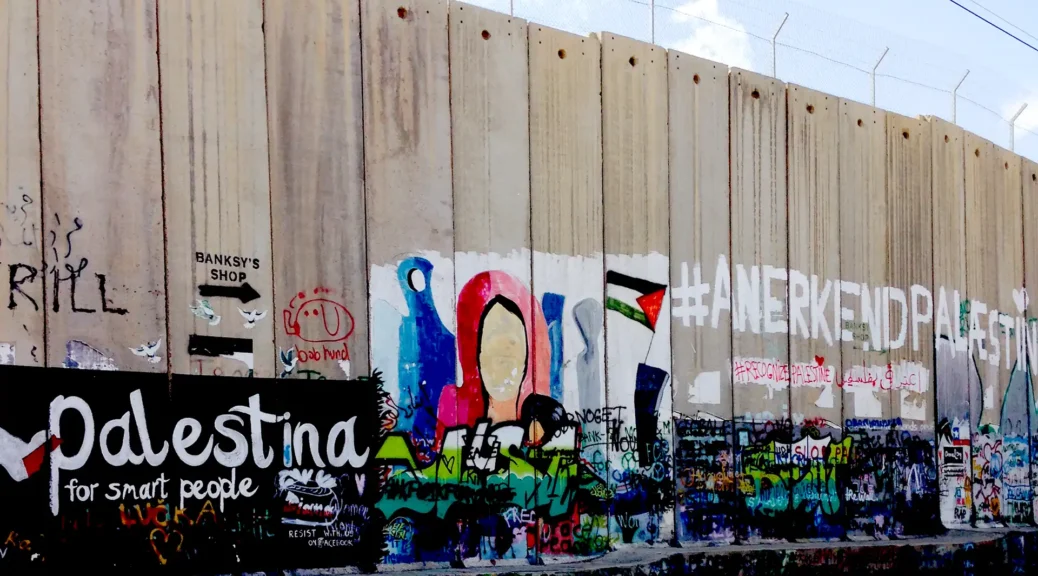
I was struck by how subdued and joyless the mood was across the communities we visited. Given all the ways freedoms were being curtailed in the West Bank, it wasn’t surprising that this was the case there. The constraints placed on people’s day-to-day lives were starkly visible in the military checkpoints separating the West Bank from Israel and the numerous refugee camps Palestinians were packed into. Yet the most powerful symbol of this absence of freedom was the wall that separated the West Bank from Israel. The portion that we walked alongside in Bethlehem was almost thirty feet high. The top lip of the structure bent in toward the West Bank to make the barrier harder to scale; that, along with its height, made the wall literally loom over the territory. It seemed to be taunting the Palestinians, reminding them that while they might govern West Bank cities, those cities would always be surrounded by areas under Israeli control.
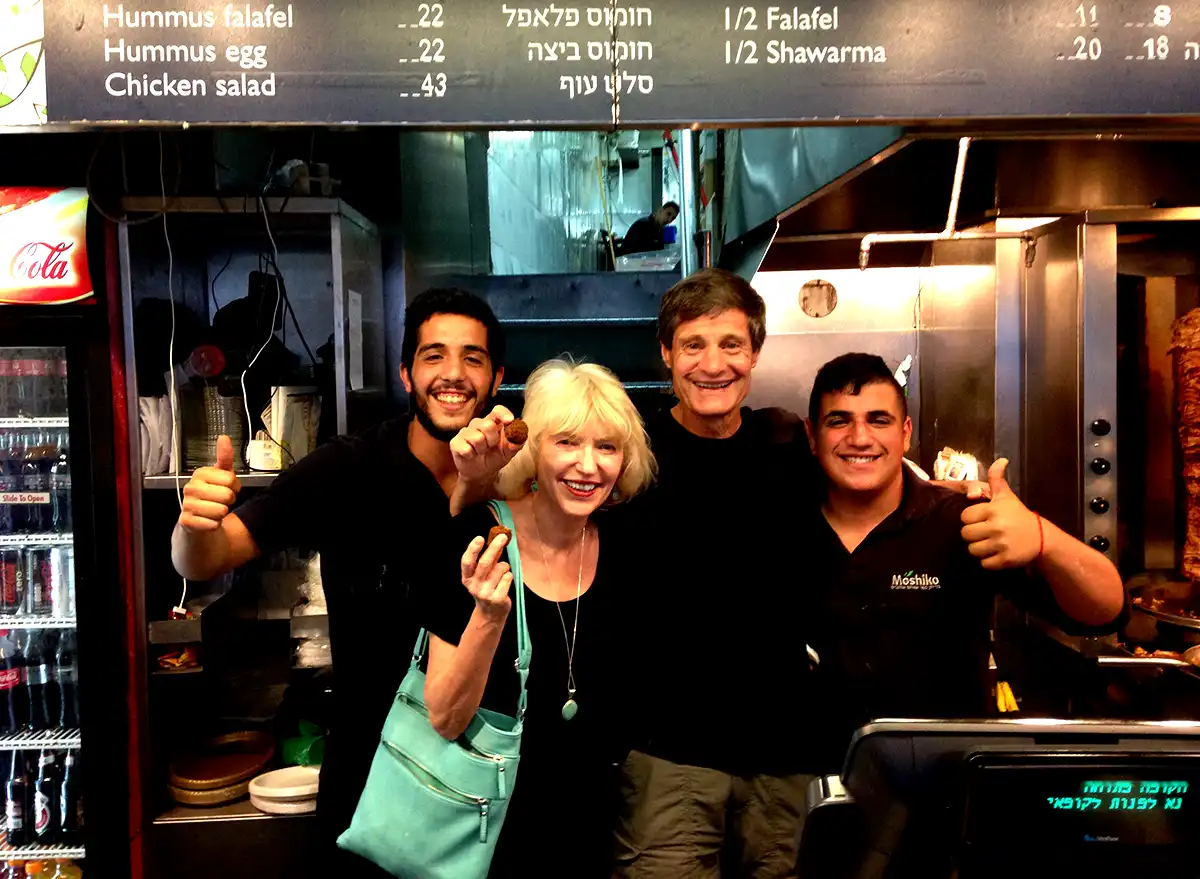
Were there exceptions, evidence of lighter spirits? Absolutely. There was the Israeli teenager who ran out of a Jerusalem bakery with a ten shekel note I’d dropped inside. She handed it to me with a huge, glowing smile, delighted to do a generous deed. There were the four boys who worked in the Falafel King café in Jerusalem. At a moment when the café was free of customers except for us, one of the boys grabbed Mardena, another grabbed me, and they both started dancing with us. The other two boys clapped, and all six of us laughed while techno music thumped in the background.
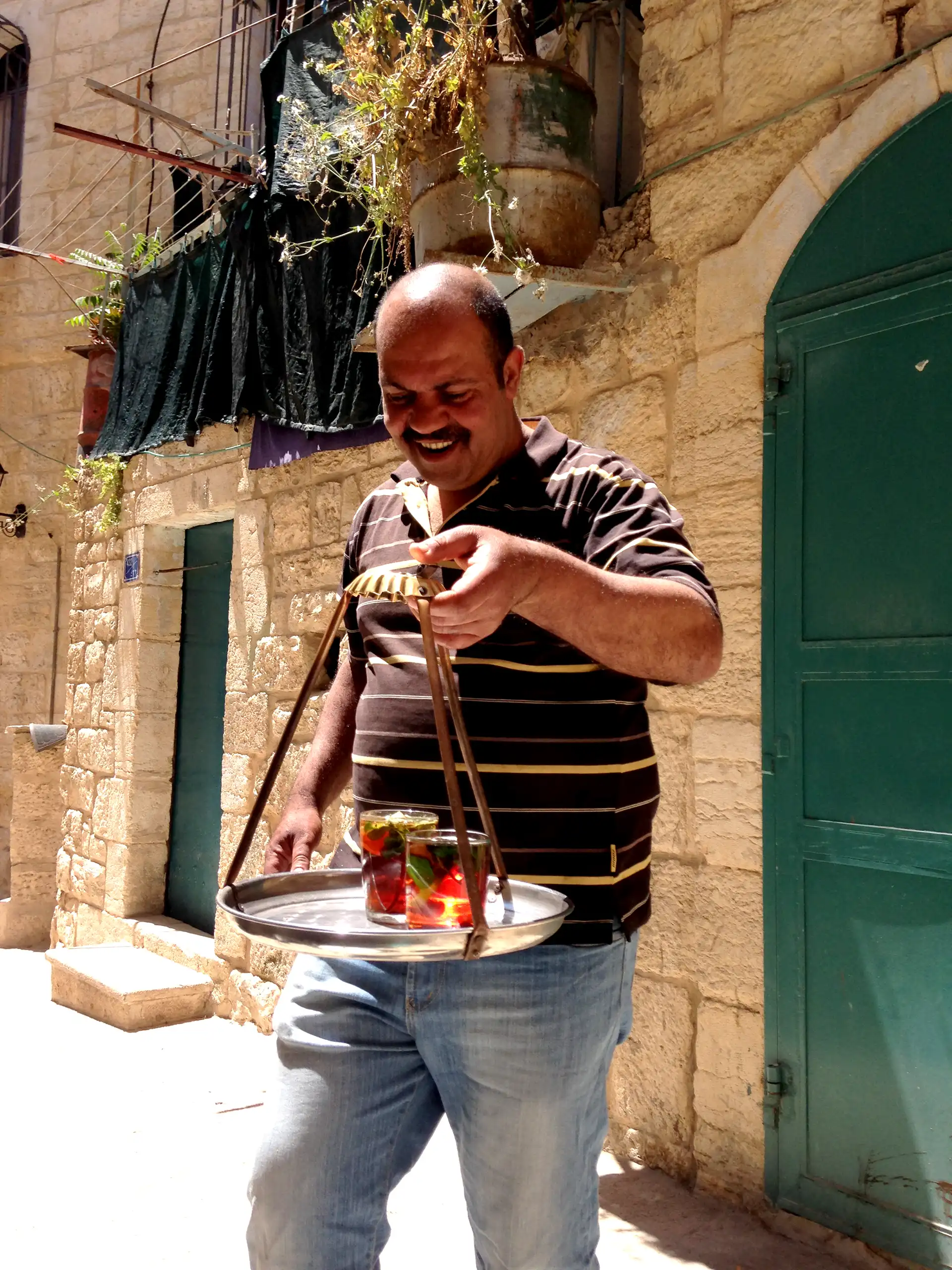
In Bethlehem there was Sami, an enterprising tea merchant who intercepted us on the street and coaxed us into his shop to sample his wares. I’d pegged him as a run-of-the-mill hustler, but I was wrong. He diligently toiled over our tea in his nook along a rock wall, eventually presenting us with the concoction he’d scrabbled together, a tangle of green leaves and stems poking out of the steaming water. It was the most delicious tea I’ve ever tasted. I asked him what was in it. “I experimented,” he said excitedly, reeling off a list of herbs and spices. When we finished, I walked to his nook and asked what we owed him. “Whatever you want to pay,” he said quietly. He saw himself as an artist, working not for profit, but to create the most pleasing of brews.
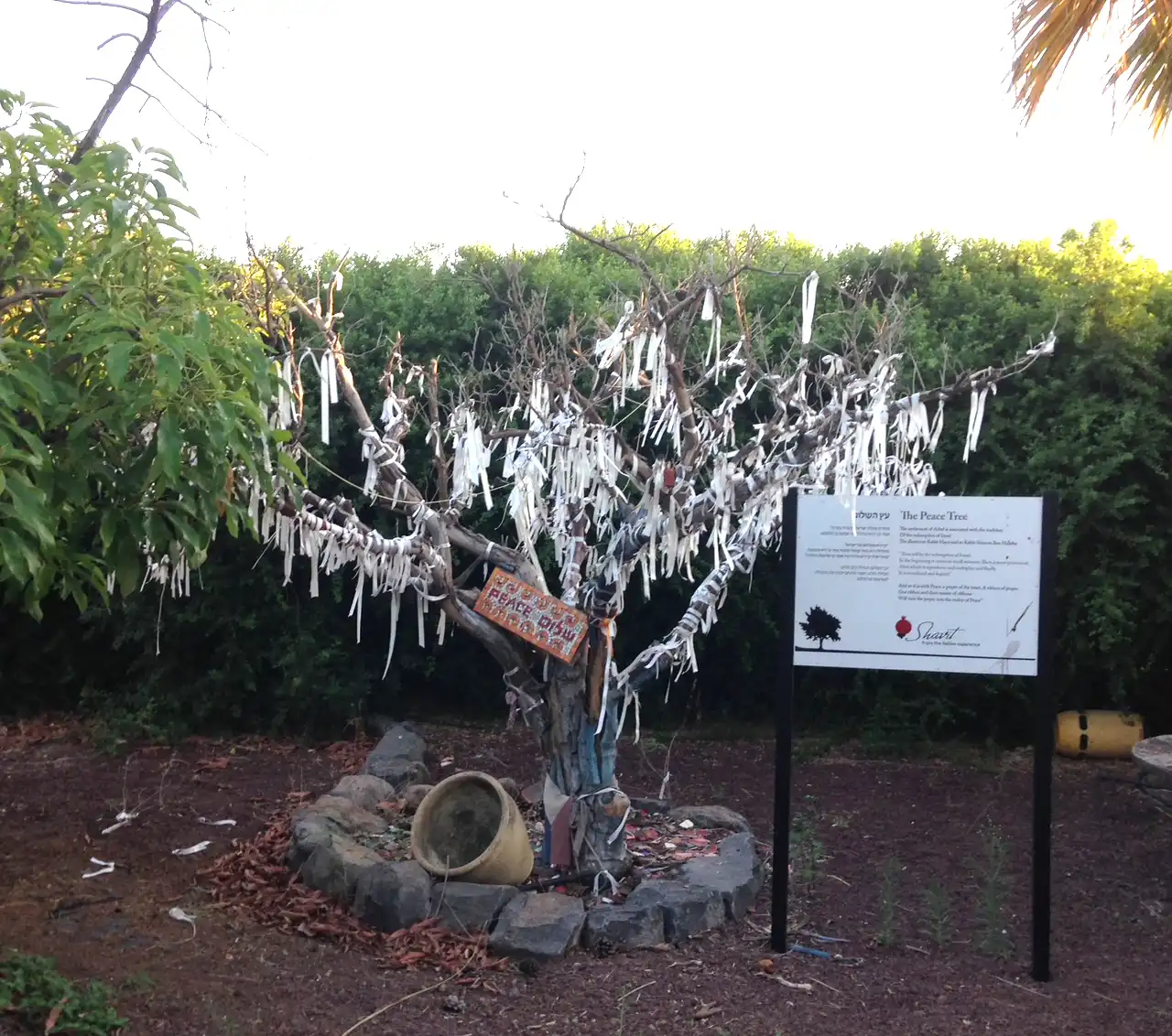
The night before Mardena and I left Israel, we stayed in a family guesthouse in Arbel, a cooperative agricultural village. Decades before, Arbel had been home to Palestinians, but when the 1948 Arab-Israeli War ended with an Israeli victory, they were expelled. Behind the guesthouse Mardena and I found a plot of trees and shrubs that its owners had designated as a peace garden. One tree was draped with paper strips that previous guests had placed there to express their support for peace. It wasn’t clear if the garden was meant in part to signify fellowship with the displaced Palestinians, but regardless, in a region so plagued with resentment and distrust, it was heartening to find an emphatic endorsement of another way of thinking.
Experiences like these were among the most memorable instances of warmth and goodwill I’d encountered in decades of travel. Yet what stood out to me most about my stay in Israel and Palestine was the disparity in power, present in every juxtaposition. Israeli flags flown with impunity in the Arab quarter of Jerusalem’s Old City. Sleek, gleaming-white settlements not far from dreary refugee camps. Israeli civilians brandishing rifles on a Tel Aviv beach, while Palestinian civilians in Ramallah had to make do with a statue of a guerrilla bedecked with fake ammunition.
If the West Bank wasn’t a lot different from what I’d expected—frustration, deprivation, and everyday struggle—what I didn’t expect was that Israel would feel like a country so much on edge, anxious about its safety and primed to defend itself. To a lesser but still substantial degree, the Israelis were also living constrained lives. They were hemmed in not by walls and privation, but by the threat of violence from within and without. Yet even a country perpetually on high alert could not ward off every threat. A decade later, that would become all too clear.
Paul Michelson Paul Michelson lives and writes in Davis, California.
- Follow us on Twitter: @inthefray
- Comment on stories or like us on Facebook
- Subscribe to our free email newsletter
- Send us your writing, photography, or artwork
- Republish our Creative Commons-licensed content